How AI Is Reshaping Logistics in Indonesia: The Rise of Scalable Customer ConversationsA
 by
by 
There’s a moment every customer goes through.
You place an order.
You track it.
Everything looks fine.
Until suddenly… it doesn’t.
The status freezes.
The timeline feels wrong.
The delivery doesn’t add up.
And instinct kicks in, you reach out. That’s when the real experience starts.
Not in the warehouse.
Not in the last-mile delivery.
But inside the conversation.
For years, logistics companies believed speed defined success. Faster deliveries meant better service. Bigger infrastructure meant stronger control. But as e-commerce exploded across Indonesia and shipment volumes scaled into millions, a different kind of pressure began to surface.
Not operations.
Not delivery.
But communication.
Customers no longer wanted just tracking updates. They expected clarity, reassurance, and real-time answers. And suddenly, the biggest challenge in logistics ai indonesia was no longer moving packages, it was managing conversations at scale. That’s exactly where Conversational AI started changing the system.
Quietly.
Seamlessly.
But at scale.
Why Communication Became the Real Bottleneck
As e-commerce growth accelerates across Indonesia, every delivery generates multiple customer touchpoints. Customers constantly seek updates, reassurance, and explanations when delays occur. This surge in interaction has exposed the limitations of traditional Customer Support, which was designed for resolution, not for handling millions of conversations simultaneously.
The problem is not the lack of response, but the lack of intelligent communication. This is where companies realized that scaling operations without improving communication leads to poor Customer Experiences. The shift toward Conversational AI is a direct response to this growing gap.
How Conversational AI Is Transforming Logistics
The introduction of Conversational AI in business models has completely transformed the way companies communicate with their clients. It allows businesses to implement a system of intelligent conversation and respond to customer inquiries immediately and effectively.
This transformation enables:
- Quick answers to high-volume customer queries
- Context-aware interactions based on delivery status
- Reduce dependency on manual Customer Support
- Consistent communication across channels like Social media, Whatsapp etc
As a result, it becomes possible for businesses to implement a proper Conversational Experience with clients.
Scaling Conversations, Not Just Deliveries
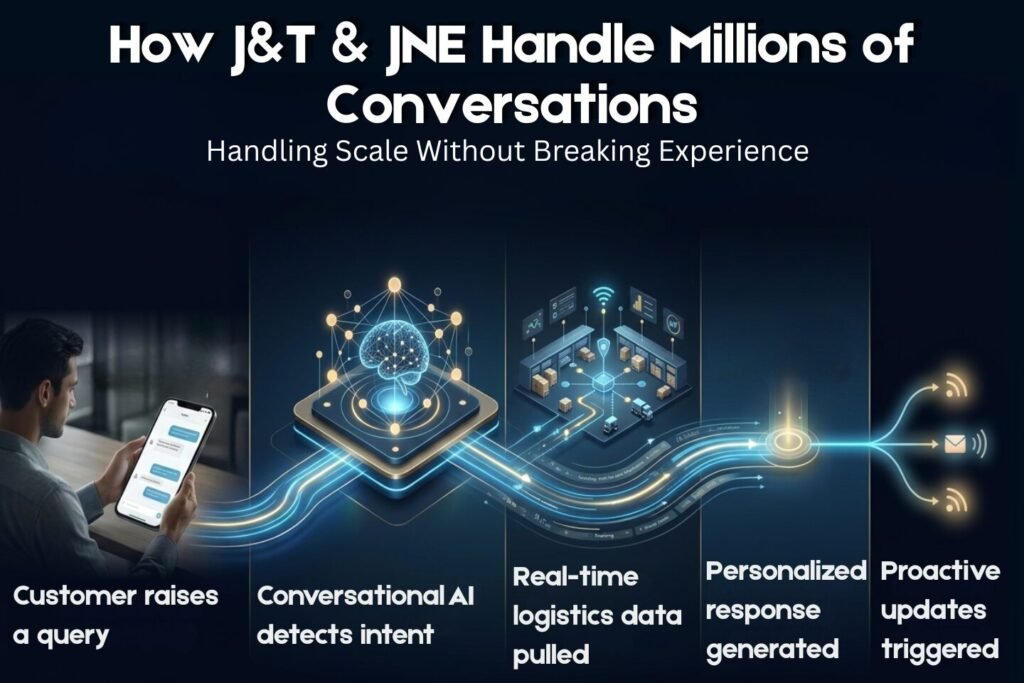
Modern logistics companies, including J&T and JNE, have started to focus on the management of conversations at scale. It means that companies have understood that communication is equally important in providing services and delivering products.
For example, when a delay occurs, customers no longer need to initiate contact. The system proactively provides updates, explains the situation, and reduces uncertainty. This integration of Conversational AI with delivery automation ensures that communication becomes a core part of the logistics process rather than an afterthought.
From Reactive Support to Predictive Communication
One of the most important aspects of Conversational AI is the move towards proactive communication instead of reactive one. Before, customers had to initiate communication to receive any type of information which led to customer dissatisfaction. Now, with the help of logistics, inIndonesia businesses are capable of predicting problems and communicating proactively. Advantages of the predictive model include:
- Notifying the customer about potential problems
- Providing Real-time, relevant updates
- Reducing inbound queries
These advantages will not only improve the efficiency of the conversation, but also make it more trustworthy as all customers will be constantly updated about their shipment.
The Expanding Role of Delivery Automation
Nowadays, the role of delivery automation goes beyond the actual process of delivery and enters the field of communication as well. With the combination of the two technologies, business can guarantee that every piece of communication becomes more convenient and effective.
The main benefits of the combination of delivery automation and Conversational AI are:
- Faster Response time without manual intervention
- Automated updates triggered by delivery agents
- Consistency across all communication channels
This creates a unified experience where operations and communication work together to deliver a smooth and reliable conversational experience.
Why Indonesia Is Leading This Transformation
The distinctive market environment in Indonesia is making logistics in Indonesia increasingly popular. This is all because of a predominantly mobile-based demographic as well as the volume of transactions that occurs within this economy, consumers have become accustomed to receiving instantaneous responses. This requirement is making businesses focus their investments on Conversational AI.
It is also the reason why conferences dedicated to the discussion of Conversational AI and customer experience, such as the Conversational AI & Customer Experience Summit Indonesia, are becoming significant events.
Final Thought: The Future Is Smarter Communication
The future of logistics does not only mean faster deliveries; rather, it means efficient communication. Customers can accept the delay in the delivery of their items, but what they definitely cannot tolerate is uncertainty. For this reason, it is necessary for logistics companies to incorporate Conversational AI, delivery automation, and intelligent customer support into their logistics processes.
It should be realized by businesses that when they make efforts in enhancing the conversational capabilities of their business, they would be creating an invaluable asset in the form of trust amongst their customers.
The future of logistics isn’t waiting, and neither should you.
While most companies are still trying to catch up, industry leaders are already implementing conversational AI at scale.
Don’t get left behind. Book your seat for the Conversational AI & Customer Experience Summit Indonesia today and be part of the shift before it becomes the standard.
FAQ’s
How are logistics companies in Indonesia using Conversational AI to handle millions of delivery queries?
Logistics leaders like J&T and JNE are using Conversational AI to automate and manage high-volume delivery conversations, creating a seamless conversational experience while reducing support load through delivery automation and real-time responses.
Why is Conversational AI becoming essential for logistics in Indonesia at scale?
Because logistics in Indonesia is no longer just about delivery, it’s about communication. Conversational AI enables companies to handle millions of customer interactions efficiently while improving conversational experience and operational speed.
How does Conversational AI improve customer support in logistics companies like JNE and J&T?
Conversational AI transforms customer support by enabling instant responses, predictive updates, and context-aware communication, helping logistics companies scale conversations without increasing manual effort.
Can Conversational AI reduce delivery delays and customer complaints in logistics ai indonesia?
Yes, Conversational AI helps detect delays early and communicate proactively, improving conversational experience and reducing customer complaints through smarter delivery automation systems.
What role does Conversational AI play in the future of logistics in Indonesia?
Conversational AI will become the backbone of logistics in Indonesia by enabling predictive communication, intelligent automation, and scalable conversational experience across all delivery touchpoints.
Why are events like the Conversational AI & customer experience summit indonesia important for logistics companies?
Events such as the Conversational AI & Customer Experience Summit Indonesia help logistics businesses get acquainted with how Conversational AI and delivery automation can impact customer engagement and operational efficiency.
How does delivery automation powered by Conversational AI improve efficiency in logistics?
Delivery automation with the help of Conversational AI minimizes the effort required manually, improves the reaction time, and creates a smooth conversational experience by responding to customers instantly.
Is Conversational AI better than traditional customer support in logistics?
Conversational AI is superior to customer support because it not only understands the user but also predicts future intentions and needs, and provides an engaging experience.
What makes conversational experience critical in delivery automation for logistics companies?
A strong conversational experience ensures customers receive real-time, contextual updates without friction. In delivery automation, this reduces confusion, improves satisfaction, and builds trust at scale using Conversational AI .
What is the biggest advantage of Conversational AI for logistics companies in Indonesia?
The most significant benefit of Conversational AI for logistics businesses in Indonesia is scalability which enables businesses to handle millions of conversations without compromising quality.