Customer Satisfaction Isn’t Predicting Growth Anymore. Here’s What Leading Enterprises Measure Instead.
 by
by 
For decades, customer satisfaction was considered the gold standard of customer experience.
Executives tracked it. Boards reviewed it. Teams optimized for it. Entire customer experience strategies were built around improving satisfaction scores.
Yet some of Asia’s fastest growing enterprises have quietly started treating customer satisfaction as a lagging indicator. Not because satisfaction no longer matters. Because it tells you what happened after the customer experience is already over.
And by then, the most important business decision has already been made. The customer either moved forward. Or they didn’t. That realization is forcing enterprise leaders across Asia to rethink one of the oldest assumptions in customer experience.
The biggest growth problem is no longer dissatisfaction. It is hesitation.
Most enterprises think they’re adopting Conversational AI. The companies moving fastest are doing something entirely different. Discover the Customer Experience Shift Across ASEAN.
The Most Expensive Customer Experience Problem Rarely Appears in Dashboards
All businesses are great at measuring results. They measure:
- Conversion ratios
- Abandonment ratios
- Retention ratios
- Net Promoter Scores (NPS)
- Customer Satisfaction ratios
There is one thing that many organizations fail to measure though:
The point where a customer loses confidence. It may come as a surprise, but detecting this point is very hard to do.
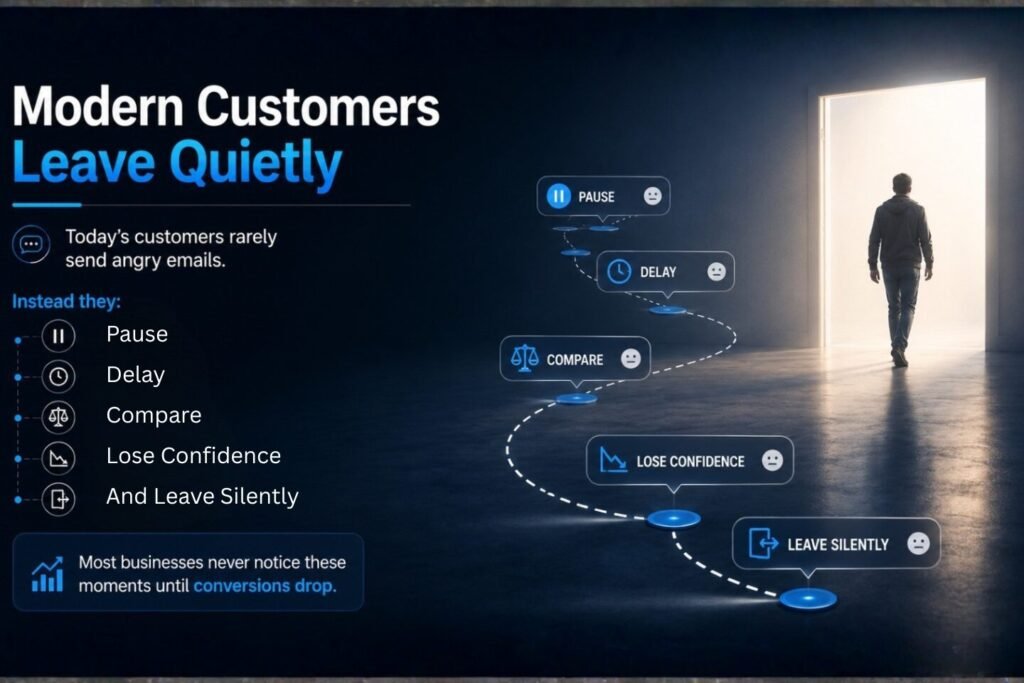
The customer comes to your website. They find the perfect item. They like the pricing. The offer seems great. They get an inquiry. Very small actually. Maybe they need to clarify something. Maybe they need some reassurance. Maybe they require further confirmation in order to take the next step. The answer takes too long to give. The customer hesitates. Hesitation turns into uncertainty. Uncertainty leads to comparison. Comparison diverts attention. And the deal goes out the window. The business never knows when exactly their customers’ confidence left.
But it happens all the time. Every day thousands and thousands of times. The fastest-growing companies in Asia got obsessed with trying to understand this point. Because they understood one simple thing about the customer experience:
People don’t abandon products; they abandon confidence.
Why Asia Became the World's Most Advanced Customer Behavior Market
When it comes to Asia’s story of growth, many tend to think that the population factor plays a pivotal role. Nothing could be farther from the truth. Asia emerged as one of the leading testing grounds for customer experience due to the fact that customer behavior progressed faster than the enterprise infrastructure.
Mobile usage skyrocketed. Messaging became the default way of communication. E-commerce became commonplace. Expectations started changing rapidly. Customers became used to immediate responses. Immediate recommendations. Immediate answers. Immediate reassurance.
As expectations grew, responsiveness ceased to become a performance measure. It became a trust measure. In today’s age, customers’ decision-making is frequently influenced by how effortless interaction with a business becomes.
Not only the quality of products. Not only prices. Not only brand awareness. Effortlessness became an edge. And all of that due to one behavioral change alone. Conversational AI adoption became so quick because the aim wasn’t just automation. The aim was the reduction of hesitations into abandonment.
The Enterprises Pulling Ahead Are Solving a Different Problem
Organizations continue to believe that customer experience involves assisting customers after their need for help arises. Not so with the best performing companies. They concentrate on assisting customers even before the problem becomes visible. This makes all the difference. They don’t have to wait to offer support; instead, they design solutions to minimize friction. They don’t measure customer satisfaction at the end of an interaction; instead, they measure confidence while interacting. They don’t optimize customer service but rather customer momentum.
You might say that sounds like a fine point. But it’s not. The behavior of momentum differs from that of satisfaction. Satisfaction looks to the past. Momentum looks to the future. Satisfaction assesses the feeling of customers. Momentum forecasts the behavior of customers. And that makes momentum more valuable for growth purposes.
Why Conversational AI Is Becoming Enterprise Infrastructure
Many organizations still view Conversational AI as a customer support technology. That perspective is already becoming outdated. The most advanced enterprises are no longer using Conversational AI simply to answer questions. They are using it to preserve momentum. Modern Conversational AI systems increasingly function as:
- Confidence accelerators
- Decision support systems
- Intent prediction engines
- Friction reduction layers
- Customer guidance mechanisms
This is where AI Customer Engagement becomes strategically important.
The objective is not generating more conversations. The objective is generating better decisions. When designed correctly, conversational systems shorten the distance between confusion and clarity. That creates measurable business value. Because every moment of uncertainty carries a cost. And every moment of clarity creates movement.
The Real Reason Traditional Funnels Are Breaking
Most customer acquisition models still assume people move through a linear process.
- Awareness.
- Interest.
- Consideration.
- Decision.
- Purchase.
Real customer behavior no longer works that way.
Modern customers are moving back and forth from device to device, channel to channel, tab to tab, conversation to conversation, review to review, recommendation to alternative, et cetera.
They don’t follow straight paths. They follow paths of momentum. Then hesitation. Then momentum. That is precisely what makes Customer Communication Automation such an essential focus area right now.
The importance of automation is not merely efficiency. The importance of automation is continuity. Customers shouldn’t ever be left alone between decisions. Customers shouldn’t ever be left confused between interactions.Businesses who get this right make significantly more seamless experiences. Seamless experiences equal better growth results.
The New Competitive Advantage Is Reduced Cognitive Effort
One of the simplest yet most profound learnings coming out of Asia’s most successful companies is the following:
Not all the time will customers make the best choice.
Most of the time, they’ll pick the easy choice.
An easy choice is the one that involves minimal thought.
There are cognitive costs involved in every interaction a customer makes:
- Confusion
- Waiting
- Complication
- Uncertainty
- Information overload
What the quickest growing businesses are doing now is reducing these costs. That’s the reason Real Time Customer Experience is now taking on so much importance. Customers demand clarity when there’s uncertainty. The quicker a company provides that clarity, the more momentum they retain. And momentum is quickly turning into one of the surest signs of success.
What the Best Enterprises Understand About Conversational Experience
The most advanced organizations do not consider Conversational Experience to be about customer service anymore. They consider it to be growth infrastructure. Since every conversation can affect:
- Confidence
- Trust
- Speed of decision making
- Quality of engagement
- Customer momentum
The best Conversational Experience solutions are those which are not meant to communicate more. They are supposed to reduce friction quickly. That is a completely different agenda. It is precisely why enterprise executives continue to pour money into conversational technologies, predictive engagement, and intelligent interaction platforms.
Today’s winners may not always be the ones who communicated more. But those who do better at crucial moments.
Final Insight
The biggest customer experience shift happening across Asia is not technological. It is behavioral.
For years, enterprises optimized for satisfaction. The next generation of enterprise leaders is optimizing for momentum. Because satisfaction tells you what happened yesterday. Momentum tells you what is likely to happen next.
That is why discussions on Conversational AI, Conversational Experience, AI Customer Engagement, Customer Communication Automation, Real Time Customer Experience, etc taking place at the Conversational AI & Customer Experience Summit Asia are becoming increasingly important for enterprise growth leaders.
The organizations that dominate the next decade will not simply attract attention better than their competitors. They will remove hesitation faster. They will create confidence earlier. And they will understand something most businesses still underestimate:
Growth rarely happens when customers are impressed. Growth happens when customers stop feeling uncertain and start moving forward.
FAQ's
Why are Asia's fastest-growing enterprises moving beyond customer satisfaction metrics?
Many high-growth enterprises have realized that customer satisfaction measures how customers feel after an interaction, not what happens during it. Today’s leading organizations focus on customer momentum, which measures how effectively customers move through a journey without confusion, hesitation, or friction. This provides earlier signals about revenue opportunities and customer behavior than traditional satisfaction metrics.
What is customer momentum and why is it becoming important for enterprise growth?
Customer momentum refers to the speed and confidence with which customers move toward a decision. When customers encounter uncertainty, delays, or confusion, momentum slows down and conversion rates suffer. Enterprises increasingly view customer momentum as a critical growth indicator because it directly impacts engagement, trust, and revenue outcomes.
How does Conversational AI help reduce customer hesitation?
Conversational AI reduces hesitation by providing immediate answers, contextual guidance, and personalized support at critical decision points. Instead of forcing customers to search for information, conversational systems proactively remove uncertainty, helping users make decisions faster and with greater confidence.
Why are enterprises investing heavily in Conversational Experience platforms?
Modern customers expect interactions that are fast, personalized, and context-aware. A strong Conversational Experience helps businesses reduce friction, simplify decision-making, and create seamless engagement across channels. Enterprises are investing in these platforms because they improve customer confidence while increasing conversion and retention rates.
How does AI Customer Engagement improve enterprise performance?
AI Customer Engagement enables businesses to deliver personalized interactions at scale. By analyzing customer intent, behavior, and context in real time, AI systems can provide relevant recommendations, proactive assistance, and faster responses. This improves customer trust, engagement, and operational efficiency simultaneously.
Why is customer hesitation considered an invisible revenue leak?
Customer hesitation often occurs before a customer abandons a journey. A delayed response, unanswered question, or confusing process can weaken confidence without generating any visible complaint. Because hesitation is difficult to track through traditional analytics, many enterprises underestimate its impact on revenue and customer retention.
What role does Customer Communication Automation play in modern customer experience?
Customer Communication Automation helps enterprises deliver timely, relevant, and consistent communication throughout the customer journey. By automating responses, notifications, onboarding, and support interactions, businesses can reduce delays, improve responsiveness, and maintain customer momentum at scale.
Why is Real Time Customer Experience becoming a strategic priority?
Customers increasingly expect immediate answers and seamless interactions. Real Time Customer Experience enables organizations to respond instantly to customer needs, reducing uncertainty and improving decision-making. Enterprises that provide real-time support often see stronger customer trust, higher engagement, and improved business outcomes.
How are leading enterprises measuring customer behavior differently today?
Instead of focusing only on traditional metrics like satisfaction scores and support tickets, leading enterprises are studying customer hesitation, decision velocity, interaction friction, and confidence levels. These behavioral indicators provide deeper insights into how customers make decisions and where growth opportunities exist.
Why is Asia becoming a global leader in Conversational AI and customer experience innovation?
Asia’s digital-first consumers, mobile-first behavior, and high adoption of messaging platforms have accelerated demand for faster and more intelligent customer interactions. As customer expectations continue to rise, enterprises across the region are investing heavily in Conversational AI, AI Customer Engagement, and Real Time Customer Experience strategies to stay competitive.
How does Conversational Experience influence customer trust?
Customers trust businesses that make interactions feel simple, clear, and helpful. A well-designed Conversational Experience reduces confusion, answers questions quickly, and provides reassurance during decision-making moments. This creates stronger customer confidence and improves long-term loyalty.
What is the biggest customer experience trend shaping enterprise growth in Asia?
One of the most significant trends is the shift from measuring customer satisfaction to managing customer momentum. Enterprises are increasingly focused on reducing friction, accelerating decision-making, and creating seamless conversational journeys that help customers move forward with confidence.
Why are enterprise leaders discussing these topics at the Conversational AI & Customer Experience Summit Asia?
The Conversational AI & Customer Experience Summit Asia brings together enterprise leaders exploring how conversational technologies are transforming customer engagement, communication automation, personalization, and real-time interactions. The discussions focus on practical strategies for reducing customer friction, improving trust, and driving sustainable growth through better customer experiences.