Enterprise Leaders at CACES Singapore Agreed on One Thing: Technology Is No Longer the Biggest Customer Experience Problem
 by
by 
For the last decade, enterprises believed customer experience would naturally improve as technology became more advanced.
So companies invested billions into:
- Automation platforms
- AI systems
- Conversational workflows
- Omnichannel support
- Intelligent routing
- Customer service transformation
And technically, it worked.
Businesses became faster.
Support became scalable.
Response times improved.
AI became smarter.
Operations became more efficient.
But something uncomfortable quietly started happening inside enterprise customer journeys. Customers still felt frustrated. Not because systems were broken. Not because enterprises lacked technology. But because modern customer experience problems have evolved beyond operational efficiency.
That realization quietly dominated discussions at CACES Singapore. And honestly, this summit felt very different from typical AI and automation events. This was not a summit where enterprise leaders discussed how to deploy more bots, automate more tickets, or accelerate more workflows.
This summit revealed something much deeper:
Enterprises solved speed faster than they solved human experience.
That single realization completely changed the tone of the conversations happening across the summit.
Because for the first time, many enterprise leaders openly acknowledged something businesses rarely say publicly:
Automation reduces effort. But it did not reduce emotional friction. And emotional friction is now becoming one of the biggest invisible growth problems inside modern enterprise customer experience.
The Biggest Problem in Customer Experience Today Is Invisible
One of the strongest trends throughout the summit was the recognition that customers no longer evaluate experiences based on efficiency. Customers evaluate experiences based on what they feel as they go through them.
This seems like a minor distinction. But it is actually strategically a huge shift. For decades, enterprises focused their efforts on optimizing customer experiences based on tangible operational metrics such as:
- Response speed
- Resolution time
- Ticket volume
- Automation rate
- Cost efficiency
But modern customers however experience brands psychologically, not operationally. A customer may get an immediate response from an AI and still feel confused. A workflow may technically resolve an issue and still leave the customer emotionally exhausted. An interaction may be automated perfectly and still feel mentally difficult. That is the hidden customer experience crisis enterprise leaders repeatedly discussed at CACES Singapore.
It is no longer the question of
“How quickly can we automate interactions?”
but rather
“How do we minimize the emotional resistance to interactions?”
And this is where the summit became genuinely insightful. Because enterprise leaders started discussing customer experience less like a technology challenge and more like a human behavior challenge.
The “Silent Conversational AI Crisis” Was One of the Most Important Discussions at the Summit
One of the most powerful sessions came from Raghav Kumaria, who introduced a phrase that quietly summarized the entire summit:
“The Silent Conversational AI Crisis.”
That title alone explains where enterprise customer experience is heading. Because the crisis is not that Conversational AI is failing technically. The problem is that enterprises thought that automation alone will automatically build trust, confidence, and simplicity. But customers don’t emotionally judge an AI system based on its speed alone. They judge it on:
- Clarity
- Understanding
- Contextual awareness
- Reassurance
- Conversation
And this is exactly why many enterprises are starting to discover that even highly automated customer journeys can be emotionally slow.
This insight is incredibly important. For decades, companies thought that faster interactions will lead to better customer experience.
CACES Singapore challenged this assumption. The summit repeatedly highlighted that customer frustration today often comes from something much deeper than waiting time:
- Cognitive overload
- Disconnected conversations
- Emotionally robotic interactions
- Context switching
- Interaction fatigue
That’s why Conversational Experience will quickly prove to be far more important than automation alone. The companies building customer trust most quickly are not those focused only on automation efficiency. It’s those focused on reducing emotional and cognitive load throughout the customer journey. This is a very different customer experience philosophy.
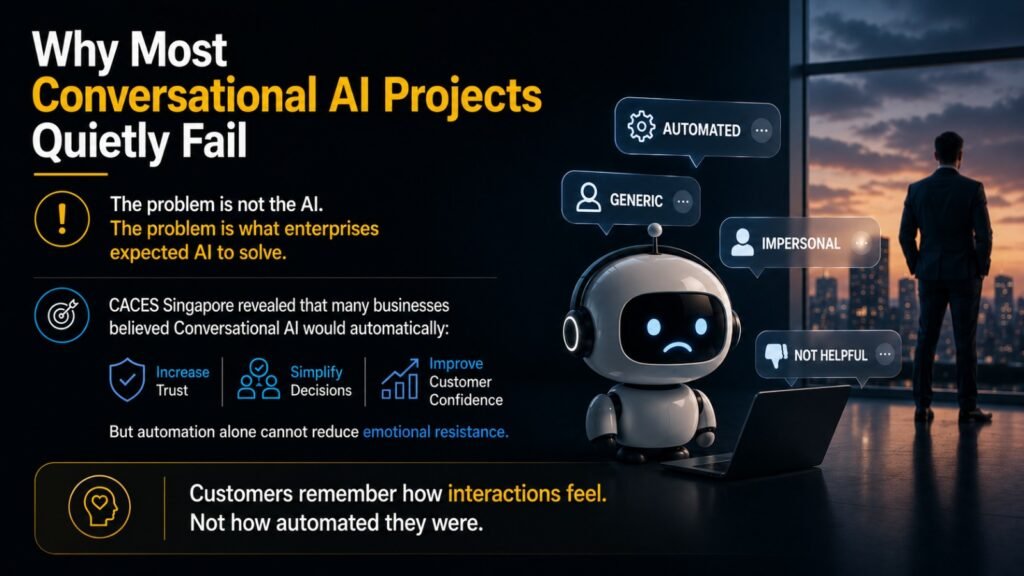
CACES Singapore Quietly Revealed Why Many Enterprise AI Strategies Will Fail
Another key takeaway highlighted by the summit was that:
AI systems lacking trust architecture will inevitably lead to customer resistance. As seen in various conversations about:
- Governance
- Explainability
- AI Orchestration
- Ethical AI
- Monitoring systems
- Human oversight
- Context aware AI
Enterprise executives openly discussed the increasing challenge of scaling intelligence responsibly. Because AI systems no longer have to answer only customer questions. But are also increasingly becoming responsible for:
- Recommendations
- Decision making
- Workflow management
- Customer assistance
- Interaction outcomes
And once AI systems begin affecting customers’ decisions, trust becomes a necessity. In this situation, the advice of prominent experts such as Dr. Kartina Sury proved to be extremely valuable. The summit reminded that the future of customer experience in the enterprise will be determined by the ability to strike a balance between:
- Intelligence
- Transparency
- Explainability
- Emotional confidence
- Human-centered design
Since enterprises have begun to understand that:
Customers will not trust the system that they can’t understand emotions. This understanding could be a turning point for the enterprise sector in this AI age.
The Most Mature Enterprises Are Quietly Moving Beyond Chatbots
One of the most apparent transitions that occurred during CACES Singapore is the transition from “AI tools” to “AI ecosystems.” The summit was not about AI assistants as most enterprise summits usually are. Rather, topics discussed by speakers such as Saurabh Mangal and Raditya Gumay included:
- AI orchestration
- Multi-agent systems
- Autonomous intelligence
- Large-scale AI operations
- Governed conversational ecosystems
Such a transition is huge. Since it signifies that enterprises no longer wonder:
“Can AI automate conversations?”
Instead, they wonder:
“Can AI sustainably govern conversation quality at enterprise scale?”
Conversational AI’s role gets redefined entirely. It is operational infrastructure. When AI becomes infrastructure, customer experience stops being only to be a support function. It becomes a business operating system. That is one of the most important strategic insights that were derived from the summit.
Why Enterprise Leaders Are Quietly Rethinking Customer Experience Entirely
The biggest takeaway from CACES Singapore is that the future of customer experience is not going to be about automation alone. It is going to be about how well enterprises manage to intelligently reduce:
- Customer confusion
- Hesitation
- Uncertainty
- Emotional exhaustion
- Cognitive overload
That is why all those discussions on AI Customer Engagement, emotional intelligence, trust-centric systems, and Conversational Experience took center stage at CACES. Because today’s enterprises are starting to realize that their customers are overwhelmed:
- Too many platforms
- Too many decisions to make
- Too many interfaces
- Too many disjointed interactions
And enterprises that persist in adding layers of complexity through ineffective automation will be gradually building customer resistance rather than customer loyalty. The enterprises shaping the future will be the ones that can make interactions:
- Easier
- Less stressful
- Clearer
- More human
- More confidence-based
That is where customer experience is headed. And honestly, CACES made that very clear.
CACES Singapore Revealed Why Human in the Loop Is Becoming Essential for Scalable Conversational AI
Why “Human in the Loop” Quietly Became One of the Most Important Conversations at CACES Singapore For years, enterprises believed the future of customer experience would become fully automated. Businesses invested heavily into Conversational AI, intelligent workflows, and AI driven customer engagement with one core assumption: the less human dependency involved, the more scalable customer experience would become. AI systems became faster, automation became smarter, and enterprises gained the ability to manage millions of customer interactions simultaneously.
But CACES Singapore revealed something much deeper. Enterprise leaders repeatedly acknowledged that while automation improved operational efficiency, it did not automatically improve emotional customer experience. Customers were still becoming frustrated during highly automated interactions because many AI systems still lacked contextual understanding, emotional sensitivity, and human judgment during critical moments.
This is exactly why “Human in the Loop” became one of the most valuable discussions throughout the summit. The more AI automates simple interactions like FAQs, order updates, and routine support, the more emotionally complex the remaining customer conversations become. What remains are interactions involving trust, reassurance, escalation handling, and sensitive decision making. These moments require more than automation speed. They require human understanding.
This is also why governance emerged as a major enterprise priority at CACES Singapore. Leaders repeatedly emphasized that Conversational AI systems without strong governance frameworks eventually create:
- Trust gaps
- Compliance risks
- Inconsistent decisions
- Emotionally robotic experiences
- Unpredictable customer outcomes
As AI becomes deeply integrated into customer journeys, governance is no longer just a compliance layer. It is becoming the foundation of enterprise trust. The smartest organizations are no longer asking:
“How much can we automate?”
They are asking:
“How do we scale intelligence without losing empathy, accountability, and human trust?”
That is a much bigger customer experience challenge.
And honestly, this may become one of the defining enterprise shifts of the next decade.
Because the future of Conversational Experience will not belong to companies that remove humans completely. It will belong to the organizations capable of combining:
- AI speed
- Human empathy
- Governed intelligence
- Contextual understanding
into one seamless customer experience.
Final Insight
The biggest realization from CACES Singapore was not technological. It was psychological.
For years, enterprises believed customer experience problems could be solved through faster systems, larger automation layers, and more advanced AI infrastructure. But customers are proving something very different. People do not remember experiences only because they were fast. They remember experiences because they felt:
- Understood
- Reassured
- Guided
- Emotionally easy
That is why enterprise leaders throughout the summit repeatedly emphasized that the next generation of customer experience will not belong to companies with the most automation.
It will belong to the companies that reduce emotional friction fastest. And that may become one of the most important enterprise shifts of the next decade. Because while many organizations are still trying to automate customer journeys, the most mature enterprises are quietly learning how to humanize intelligence itself.
FAQ's
Why did enterprise leaders at CACES Singapore say automation is no longer enough for customer experience?
At CACES Singapore, enterprise leaders repeatedly highlighted that businesses spent years optimizing automation, but customers still experience frustration, confusion, and emotional disconnect during digital interactions. The summit revealed that modern customer experience problems are no longer caused by lack of technology. The real challenge is reducing emotional friction through intelligent Conversational AI, trust driven AI Customer Engagement, and more human Conversational Experience systems that make interactions feel easier and more reassuring.
What was the biggest hidden customer experience problem discussed at CACES Singapore?
One of the strongest insights from CACES Singapore was that enterprises unknowingly created highly efficient but emotionally exhausting customer journeys. Businesses improved response speed using Conversational AI and Customer Communication Automation, but many customers still feel mentally overloaded while interacting with brands. Enterprise leaders agreed that reducing cognitive effort and simplifying decision making will become one of the most important priorities in the future of customer experience.
Why are enterprises moving from chatbot automation to Conversational Experience design?
The summit revealed that enterprises are realizing customers no longer want robotic workflows or disconnected support experiences. Modern customers expect intelligent guidance, contextual understanding, and emotionally smooth interactions. This is why enterprises are investing heavily in Conversational Experience systems that combine Conversational AI, AI Customer Engagement, and Real Time Customer Experience strategies to create interactions that feel natural, continuous, and confidence driven.
Why did CACES Singapore focus so heavily on trust in Conversational AI systems?
Trust became one of the biggest discussion themes because enterprises are now using Conversational AI systems to influence recommendations, customer decisions, and business interactions at scale. Speakers explained that customers may stop trusting AI systems that feel unpredictable, emotionally disconnected, or difficult to understand. This is why enterprise leaders are focusing on explainability, governance, transparency, and emotionally aware AI Customer Engagement systems that build confidence instead of resistance.
What does “The Silent Conversational AI Crisis” actually mean for enterprises?
“The Silent Conversational AI Crisis” discussed at CACES Singapore refers to the growing gap between automation efficiency and emotional customer satisfaction. Enterprises successfully automated customer interactions using Conversational AI, but customers still experience confusion, hesitation, and frustration during digital journeys. The summit revealed that businesses must now optimize for emotional clarity and Conversational Experience quality instead of focusing only on automation metrics.
Why are enterprises treating Conversational AI as business infrastructure instead of support technology?
Enterprise leaders at CACES Singapore explained that Conversational AI is evolving beyond chatbots and support automation. Businesses are now building enterprise wide conversational ecosystems powered by AI orchestration, predictive intelligence, and Customer Communication Automation. These systems continuously manage customer interaction quality, guide decision making, and improve Real Time Customer Experience across multiple touchpoints.
Why is emotional intelligence becoming more important than automation in customer experience?
One of the strongest insights from CACES Singapore was that automation solved operational speed but failed to solve emotional understanding. Customers now evaluate brands based on how supported, understood, and reassured they feel while interacting digitally. This is why enterprises are redesigning customer journeys using Conversational Experience frameworks, emotionally intelligent AI Customer Engagement systems, and human centered interaction models.
How is Conversational AI changing enterprise customer experience strategy across Asia?
The summit revealed that enterprises across Asia are redesigning customer experience around speed, trust, and interaction simplicity. Businesses are combining Conversational AI, Real Time Customer Experience systems, and AI Customer Engagement models to reduce hesitation, eliminate friction, and improve customer confidence during critical decision moments. The companies leading this shift are creating customer journeys that feel faster, clearer, and more emotionally intelligent.
Why are enterprises struggling to scale customer trust even after investing heavily in AI?
Enterprise leaders explained that technology alone cannot create customer trust automatically. Many businesses focused heavily on automation, workflows, and operational efficiency while ignoring emotional customer behavior. CACES Singapore revealed that customers trust brands that reduce confusion, simplify interactions, and create smoother Conversational Experience environments. Enterprises that fail to humanize AI systems may struggle to build long term customer confidence.
What is the future of customer experience after the insights shared at CACES Singapore?
The future of customer experience will not belong to companies with the most automation or the largest AI infrastructure. Enterprise leaders at CACES Singapore agreed that future market leaders will be businesses capable of reducing emotional friction faster than competitors. Organizations investing in Conversational AI, AI Customer Engagement, Customer Communication Automation, and Real Time Customer Experience systems that make interactions feel easier, calmer, and more human will define the next era of enterprise growth.