The End of Chatbots? What Indonesia’s Biggest Conversational AI & Customer Experience Summit Reveals About the Future
 by
by 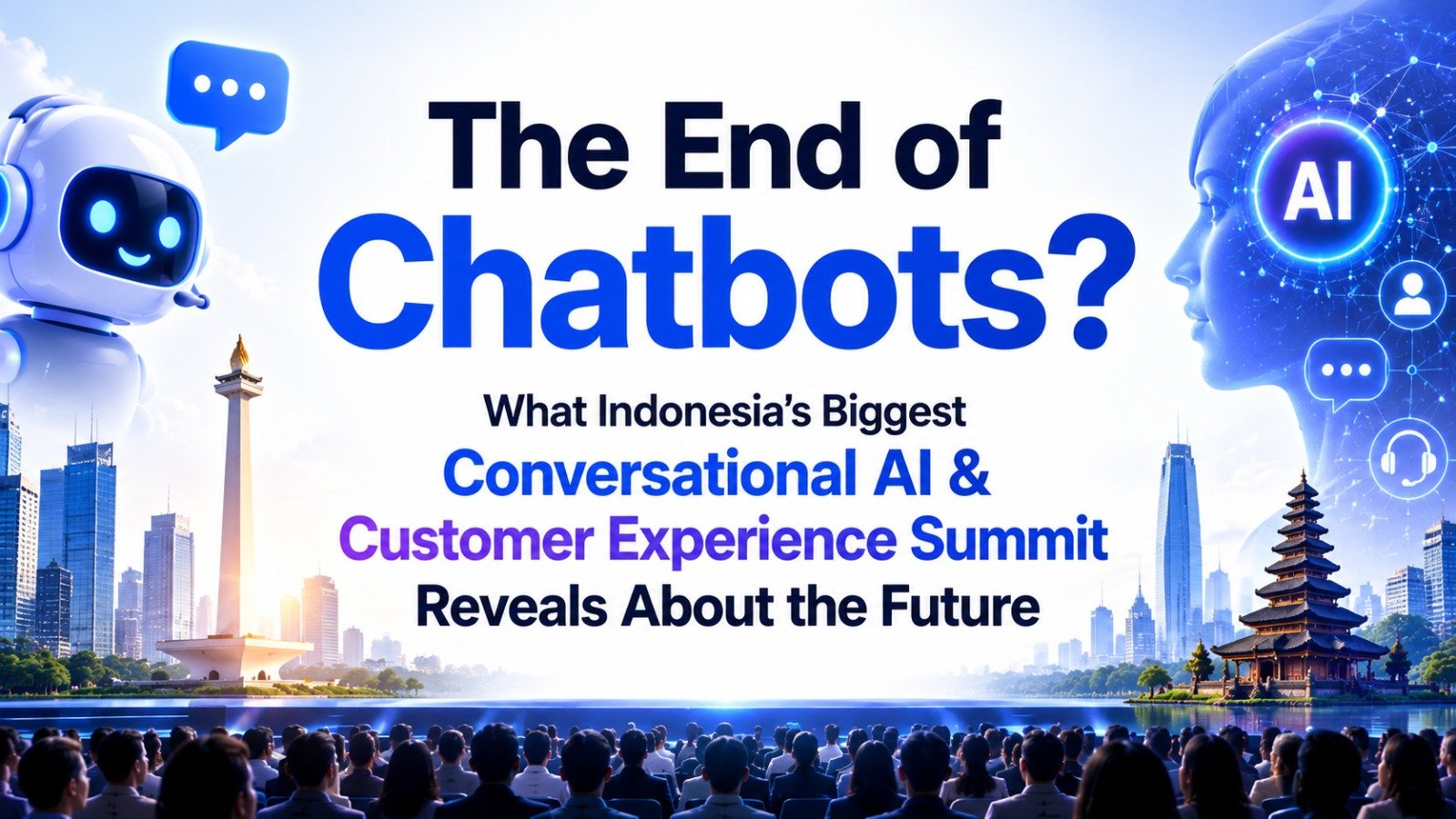
Customer experience is no longer being transformed by chatbots alone, it is being redefined by intelligent AI agents capable of understanding context, orchestrating workflows, and delivering personalized interactions at scale. That shift was the defining theme of the 12th Conversational AI & Customer Experience (CACES) Summit Indonesia 2026, where technology leaders, CX executives, and AI innovators explored how enterprises are moving beyond automation to build customer-centric, AI-driven organizations.
Across keynote sessions from Kore.ai, Genesys, Prudential Indonesia, Kapture CX, Ninja Van Malaysia, and discussions involving leaders from Telkomsel, JNE, and other major enterprises, one message stood out: the future of customer experience belongs to organizations that combine AI intelligence with human trust.
Here are the biggest insights from the summit.
1. Enterprise AI Is Moving Beyond Chatbots
One of the strongest themes throughout the summit was the industry’s transition from conversational interfaces to intelligent AI agents.
Abhijit Mhetre of Kore.ai explored how customer service operating models are being redesigned to generate measurable business impact rather than simply improving operational efficiency. Later in the day, Nachiket Pathki from Kapture CX expanded on this evolution by discussing the architecture of autonomous customer experience platforms, highlighting the move away from fragmented technology stacks toward integrated AI ecosystems.
This shift reflects a broader transformation happening across global enterprises.
According to McKinsey, generative AI could contribute between $2.6 trillion and $4.4 trillion in annual economic value, with customer operations representing one of the highest-value business functions for AI adoption.
Enterprise AI Evolution Framework
Phase | Primary Objective | Business Impact |
Rule-Based Chatbots | Answer FAQs | Lower support costs |
Conversational AI | Improve customer interactions | Better engagement |
LLM-Powered Assistants | Understand intent and context | Higher productivity |
AI Agents | Execute workflows and make decisions | Business transformation |
The conversation has clearly shifted from building better chatbots to creating AI systems capable of completing complex business tasks.
2. Customer Experience Has Become an Orchestration Challenge
Modern customers expect businesses to remember every interaction, regardless of whether it occurs through voice, email, WhatsApp, websites, or mobile applications.
This growing complexity was reflected in Louis Teoh’s keynote from Genesys, which focused on customer experience orchestration rather than isolated channel optimization. Similarly, Arian Achmad Prasetio from Rukita discussed how AI can transform customer experience into a sustainable competitive advantage by connecting data, automation, and personalization.
The challenge facing enterprises today is no longer channel expansion. It is orchestration.
Salesforce’s State of the Connected Customer research reports that 88% of customers say the experience a company provides is as important as its products or services, while 73% expect companies to understand their unique needs and expectations.
Meeting these expectations requires more than conversational AI. It requires a unified customer intelligence layer capable of connecting CRM platforms, knowledge bases, enterprise applications, and customer history into a single decision-making engine. Organizations that continue deploying disconnected AI solutions risk creating fragmented customer journeys instead of seamless experiences.
3. Trust Is Becoming the New Competitive Advantage
While artificial intelligence continues to become more capable, customer trust has not grown at the same pace.
This challenge emerged as one of the summit’s most important discussions.
Karin Z., Chief Customer & Marketing Officer at Prudential Indonesia, explored how organizations can balance automation with customer trust in increasingly digital environments. Complementing this perspective, Dr. Kartina Sury emphasized human-centered AI design and the importance of building trustworthy AI conversations.
The message is timely.
According to IBM’s Global AI Adoption Index, executives increasingly view governance, transparency, and responsible AI as strategic priorities rather than regulatory obligations.
The Trust Gap Framework
AI capability continues to accelerate. Customer confidence grows more gradually. Organizations that close this gap through explainability, governance, privacy protection, and human oversight will build stronger customer relationships than those relying solely on automation.
Trust is no longer a compliance requirement. It is a competitive differentiator.
4. Customer Experience Is Finally Becoming a Boardroom Metric
For many years, conversational AI projects were evaluated using operational metrics such as average handling time, chatbot containment rate, or ticket deflection.
Those measurements are becoming insufficient.
Sandra Samuel from Ninja Van Malaysia opened the summit by discussing scalable customer experience systems driven by better decision-making rather than isolated performance metrics. Later sessions focused on executive buy-in, measurable customer loyalty, and return on investment, reinforcing the idea that AI initiatives must demonstrate business outcomes, not just technical success.
Deloitte’s research shows that organizations achieving the greatest value from AI consistently align technology investments with measurable business objectives instead of purely operational improvements.
Forward-looking organizations are increasingly evaluating conversational AI using metrics such as:
- Customer Lifetime Value
- Net Promoter Score
- Customer Retention
- Revenue Growth
- First Contact Resolution
- Customer Effort Score
This represents a significant shift in executive thinking. The question is no longer whether AI can automate customer interactions. The question is whether AI can improve business performance.
5. Indonesia Is Emerging as Southeast Asia's Enterprise AI Innovation Hub
Perhaps the most encouraging takeaway from the summit was the diversity of industries represented. The agenda brought together executives from telecommunications, insurance, banking, logistics, hospitality, retail, e-commerce, financial services, and technology companies, including leaders from Telkomsel, JNE, Home Credit Indonesia, FWD Insurance Indonesia, NETS, Flip, and InJourney Hospitality.
This diversity reflects a larger regional trend. Enterprise AI adoption is no longer concentrated within technology companies. It has become a strategic priority across virtually every customer-facing industry.
Indonesia’s rapidly growing digital economy, expanding smartphone adoption, and increasing enterprise investment in cloud infrastructure create favorable conditions for conversational AI innovation.
Rather than asking whether conversational AI belongs in the enterprise, Indonesian organizations are focusing on more advanced questions:
- How can AI support multilingual customer engagement?
- How can AI comply with governance requirements?
- How can AI deliver measurable return on investment?
- How can AI collaborate effectively with human employees?
Those questions signal a market that has moved beyond experimentation and into enterprise-scale implementation.
Key Executive Takeaways
- AI agents are becoming enterprise platforms, not just customer support tools. Organizations are shifting from answering customer questions to automating complete business workflows.
- Customer experience is evolving into an orchestration challenge. Success depends on connecting CRM, knowledge bases, voice, messaging, and business applications into one intelligent ecosystem.
- Trust is emerging as the most important differentiator. Explainable AI, governance, transparency, and privacy are becoming competitive advantages rather than compliance requirements.
- Business outcomes matter more than automation metrics. Forward-looking organizations measure AI success through customer retention, loyalty, revenue growth, and lifetime value.
- Indonesia is accelerating enterprise AI adoption. The diversity of industries represented at the summit highlights that conversational AI is becoming a strategic priority across banking, telecom, retail, insurance, logistics, and hospitality.
Conclusion: The Next Competitive Advantage Will Not Be AI. It Will Be AI That Understands Customers.
The biggest takeaway from the Conversational AI & Customer Experience Summit Indonesia 2026 is not that conversational AI is becoming more powerful. It is that enterprises are redefining customer experience around intelligent systems that combine reasoning, personalization, governance, and measurable business outcomes. Across sessions from Kore.ai, Genesys, Prudential Indonesia, Kapture CX, Ninja Van Malaysia, and panel discussions featuring leaders from Telkomsel, JNE, Home Credit Indonesia, and others, a common narrative emerged. AI is evolving from a productivity tool into a strategic business capability.
Organizations that continue treating conversational AI as a standalone chatbot initiative risk falling behind competitors that are investing in enterprise-wide AI orchestration. The next phase of customer experience will be defined by systems that understand context, automate workflows, learn continuously, and seamlessly hand over to human experts when empathy or judgment is required.
For business leaders across Southeast Asia, the opportunity is no longer about deploying AI. It is about building an intelligent customer experience ecosystem where technology and people work together to deliver faster service, stronger relationships, and measurable business growth.
The organizations that start this transformation today will likely define the customer experience standards of tomorrow.
FAQ's
The summit highlighted the transition from traditional chatbots to intelligent AI agents capable of understanding context, automating workflows, improving customer engagement, and delivering measurable business value across the enterprise.
Traditional chatbots primarily answer predefined questions. AI agents can reason across multiple data sources, retrieve enterprise knowledge, automate business processes, personalize interactions, and collaborate with human employees, making them significantly more valuable for enterprise customer experience.
As AI handles more customer interactions, organizations must ensure transparency, data privacy, governance, explainability, and human oversight. Trust directly influences customer loyalty, regulatory compliance, and long-term AI adoption.
Modern conversational AI helps organizations deliver faster response times, personalized recommendations, consistent omnichannel experiences, proactive support, and improved operational efficiency while allowing human agents to focus on more complex customer needs.
Based on the summit agenda, conversational AI adoption is accelerating across telecommunications, banking, insurance, logistics, retail, hospitality, financial services, healthcare, and e-commerce, demonstrating broad enterprise demand.
As conversational AI gains greater autonomy, business risks extend beyond technology. Executive teams must address data privacy, regulatory compliance, explainability, cybersecurity, and ethical decision-making. Governance is becoming a strategic concern because customer trust directly influences adoption, brand reputation, and long-term business performance.
The transition begins with treating AI as an enterprise platform instead of a customer service application. This requires investing in high-quality enterprise data, scalable cloud infrastructure, responsible AI governance, and cross-functional collaboration between customer experience, IT, security, and business teams. Organizations that modernize these foundations today will be better positioned to adopt increasingly autonomous AI systems over the next few years.
Increasingly, yes. Enterprises are moving beyond viewing conversational AI as a customer support tool and are integrating it into broader business strategies. Discussions throughout the summit reflected how organizations across banking, insurance, logistics, retail, and telecommunications are embedding conversational AI into customer engagement, operations, and decision-making. This shift suggests that conversational AI is evolving into a core business capability rather than a standalone technology investment.
Traditional chatbots excel at answering predefined questions but often struggle with complex customer journeys. AI agents extend these capabilities by understanding context, retrieving enterprise knowledge, automating workflows, and coordinating actions across multiple business systems. This evolution was reflected in sessions from Kore.ai and Kapture CX, which focused on redesigning customer service operating models and autonomous customer experience architectures.
One of the most common misconceptions is that conversational AI is simply a more advanced chatbot. In reality, enterprise conversational AI is evolving into an intelligent operating layer capable of understanding customer intent, accessing enterprise knowledge, orchestrating workflows, and collaborating with human employees. The summit's focus on AI agents, orchestration, governance, and measurable business outcomes reflects this broader transformation.
Future CX leaders will need expertise beyond customer service operations. Strategic priorities will increasingly include AI governance, customer journey orchestration, enterprise data strategy, prompt engineering, AI performance analytics, and change management. As AI becomes embedded across organizations, customer experience leadership will become as much a technology discipline as a service discipline.