AI Is Getting Into the Taxi: How ESTsoft, NTT and Nihon Kotsu Are Turning Japanese Rides Into Conversational Experiences
 by
by 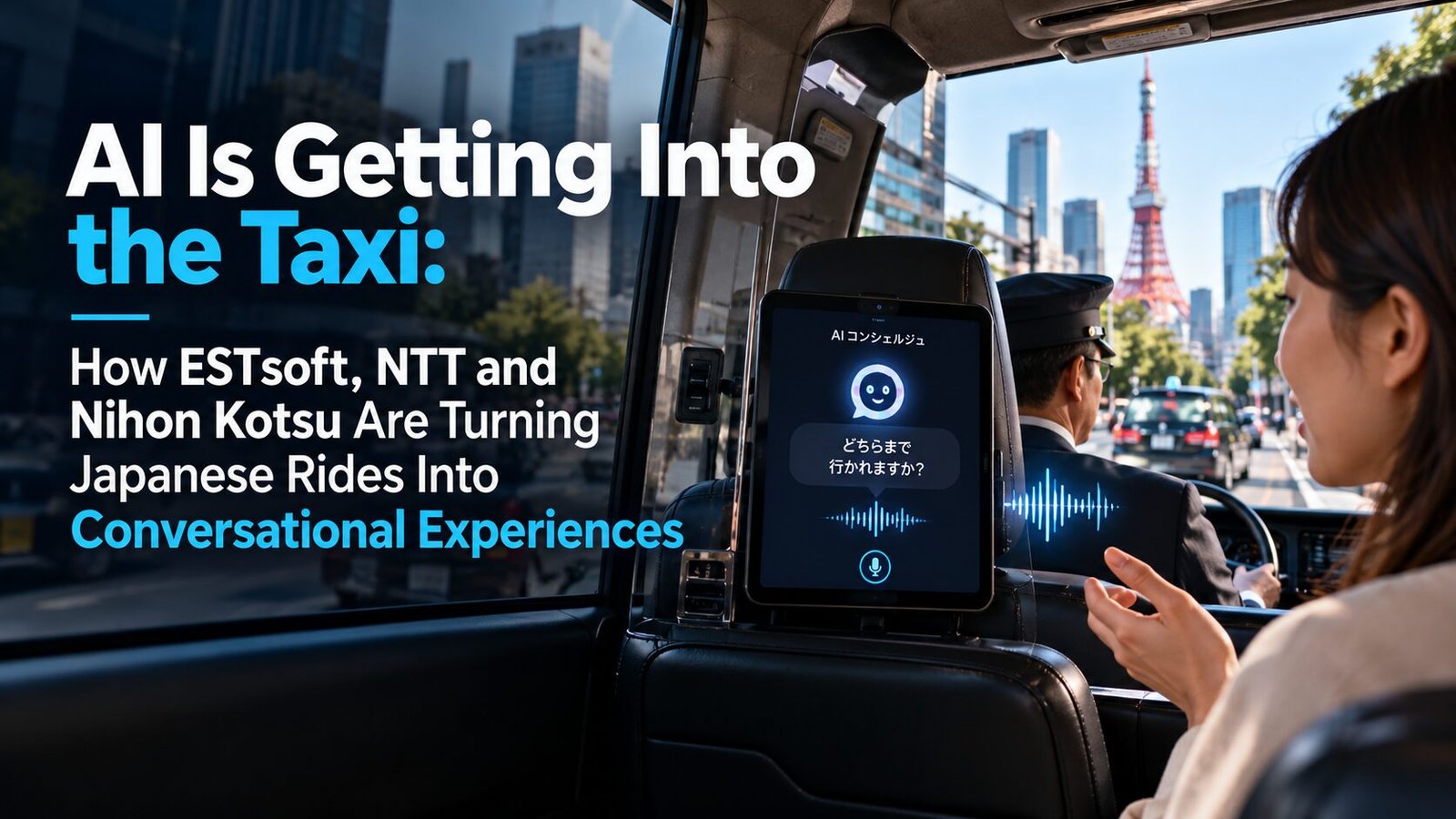
A tourist gets into a taxi in Japan. Instead of opening Google Translate, searching for a restaurant or struggling to explain a destination, they can talk to an AI avatar sitting inside the vehicle. That is the idea behind a 2026 partnership between South Korea’s ESTsoft, Japanese telecommunications giant NTT, and major taxi operator Nihon Kotsu.
The companies signed an MOU to bring Perso Interactive, ESTsoft’s real-time conversational AI avatar, into Japanese taxis. The initial proof of concept ran from February 2 to March 27, 2026, in taxis operating around Kinosaki Onsen Station, with the partners collecting passenger and driver feedback in a live transportation environment.
This is easy to describe as “AI translation in taxis.”
That description misses the bigger story.
The more important shift is that Conversational AI is moving from a screen people deliberately open into a physical environment where a customer is already having an experience. And that could be one of the most important changes in Conversational Experience design across Asia.
The short answer: What is ESTsoft putting in Japanese taxis?
ESTsoft’s Perso Interactive is being tested as a tablet-based AI avatar that can provide real-time interpretation, tourism guidance and restaurant recommendations for passengers, particularly international visitors.
The system combines AI software with the physical interface required to deliver the experience inside a vehicle. ESTsoft says the complete offering combines APIs, SDKs and hardware, rather than treating the avatar as simply another chatbot application.
Nihon Kotsu provides the real operating environment, while NTT is part of the Japanese telecommunications and mobility collaboration. Uni Electronics is also involved as ESTsoft’s Japanese partner supporting local coordination and execution.
The initial deployment matters because it puts Conversational AI into a setting where latency, language accuracy, usability and reliability have consequences immediately. A chatbot can fail and the customer can refresh the page. A taxi conversation is happening in real time, with a destination, a driver and a passenger waiting for an answer.
Why would anyone put an AI avatar in a taxi?
Because Japan has a very large customer-experience problem hiding inside a very large tourism opportunity. Japan welcomed 42.68 million international visitors in 2025, up from 36.87 million in 2024. International visitors also generated approximately ¥9.5 trillion in tourism spending in 2025. And the communication problem is not theoretical.
Japan’s Tourism Agency surveyed 4,110 international visitors between November 2025 and January 2026. 15.4% said communication with staff at facilities was a problem, while 11.3% reported difficulties using transportation and 10.9% cited insufficient or confusing multilingual signage.
There is another revealing number. Among visitors who struggled to communicate with staff, 68% said they used ICT tools to deal with the problem. So the behavior already exists. Visitors are already reaching for technology when human communication breaks down. ESTsoft’s idea is to put the technology inside the interaction itself.
This is not another translation app
That distinction is critical. A translation app waits for a person to recognize that they have a language problem, open their phone, select a language, enter or speak something, read the translation and then repeat the process.
An AI avatar changes the interaction model. The passenger can simply speak. The AI becomes the intermediary between passenger and driver, while also potentially becoming a tourism assistant. That creates three layers of value:
Communication: Help passengers and drivers understand each other.
Information: Answer questions about destinations, attractions and food.
Discovery: Turn the journey itself into an opportunity to discover something nearby.
The third layer is where Conversational AI becomes much more interesting.
From "translate this" to "what should I do next?"
Imagine a tourist leaving Kinosaki Onsen Station.
They ask:
“Can you recommend a traditional restaurant near my hotel?”
That sounds like a simple search query.
But inside a taxi, the question can become part of a larger conversation.
The passenger can ask about local food. The AI can provide information. The passenger can ask for something cheaper. They can ask whether the restaurant is open. They can ask how far it is from the hotel.
The interaction is no longer a series of isolated searches.
It becomes a Conversational Experience.
That difference is strategically important because the value of conversational interfaces is increasingly shifting from answering questions to helping people complete journeys.
Japan's tourism numbers make the taxi a surprisingly valuable AI interface
The economics make this experiment more interesting. Japan’s inbound tourism spending reached ¥2.5125 trillion in Q2 2026 alone, according to the Japan Tourism Agency’s latest second-quarter figures. Spending per general visitor reached approximately ¥245,000, up 3.4% year over year. That means the customer experience surrounding transportation is connected to a much larger economic journey.
A tourist does not buy a taxi ride in isolation. They spend on hotels, restaurants, attractions, shopping, transportation and experiences. If an AI system can reduce friction between those activities, its commercial value could extend far beyond the taxi fare. That is the bigger opportunity behind Conversational Experience in tourism.
Why Kinosaki Onsen is a smarter test than a laboratory
The initial PoC around Kinosaki Onsen Station is particularly interesting because it places the technology in an actual tourism environment rather than a controlled showroom.
ESTsoft says the trial was designed to collect usage and feedback data from both passengers and drivers and evaluate user behavior, response and overall usability under real operating conditions. That changes what is being tested. The question is not simply:
“Can the AI talk?”
It becomes:
“Can the AI help two people communicate while a real journey is taking place?”
That is a much harder technology problem.
The real test is not intelligence. It is friction.
An AI avatar can generate an impressive response in a demonstration. But transportation creates a different set of requirements. The passenger may have an accent. The driver may speak quickly. The vehicle may be noisy. The passenger may interrupt. The question may change halfway through the conversation. The customer may ask for something the AI does not know.
The system may need to understand Japanese, English, Korean or another language without turning the interaction into a technical exercise. This is why the Japanese taxi experiment is more significant than another AI avatar demonstration. The environment becomes part of the AI test.
ESTsoft is building AI that meets people "in person"
ESTsoft’s own positioning has shifted toward what it calls Physical AI. In September 2026, the company described Perso Interactive as AI designed to directly interact with people in physical spaces such as kiosks, vehicles and stores, with the goal of connecting conversation to actual action.
That framing is important. The company is not positioning Perso Interactive as simply an AI character. It is positioning the technology as an interface between intelligence and the physical world. That makes the taxi PoC a useful example of where Conversational AI could be heading next.
The screen is becoming the wrong place to think about Conversational AI
For the last decade, conversational technology has largely lived inside screens. Chatbots appeared on websites. Voice assistants appeared on smartphones. Customer-service AI appeared inside contact centers. Generative AI then made the conversational interface dramatically more capable. But all of those models share one assumption: The customer has to come to the interface. Physical AI reverses that relationship. The interface goes where the customer already is.
In a taxi.
In a store.
At an airport.
Inside a hotel.
At a tourist attraction.
On a factory floor.
That is the transition from Conversational AI to Conversational Experience.
What does an AI-avatar-powered taxi actually look like?
At a practical level, the model can be understood as four connected layers.
Layer | What happens |
Physical interface | A tablet or device gives the AI a visible, conversational presence |
Conversation layer | The passenger speaks naturally instead of typing queries |
AI intelligence | The system interprets, responds, translates and provides information |
Real-world context | The conversation happens inside a moving taxi with a destination, driver and passenger |
The important part is the last layer. The AI is not operating in a vacuum. It is embedded inside a real service journey. That is what makes this a Conversational Experience rather than simply a conversational software demo.
Why the NTT partnership matters
Technology alone is not enough. Putting Conversational AI inside a moving vehicle creates infrastructure requirements that do not exist in exactly the same way on a desktop website.
Connectivity matters.
Hardware matters.
Audio quality matters.
Latency matters.
Integration matters.
Operational support matters.
NTT brings telecommunications and mobility infrastructure into the collaboration, while Nihon Kotsu provides the operational environment needed to test the technology with actual taxi journeys. ESTsoft brings Perso Interactive, while Uni Electronics supports the Japanese execution side.
This is therefore a useful example of how physical AI may actually scale. The future may belong less to standalone AI vendors and more to combinations of AI companies, infrastructure providers and businesses that control physical customer journeys.
Nihon Kotsu turns the AI from a demo into an operating system for CX
There is a major difference between demonstrating AI in a showroom and putting it in a taxi. A showroom has predictable conditions. A taxi does not. Passengers behave differently. Journeys change. Questions are unpredictable. Drivers have operational priorities.
The system has to fit into the existing service rather than asking the service to adapt around the AI. That makes Nihon Kotsu’s role strategically important. The taxi becomes a real-world laboratory for Conversational Experience.
What could passengers actually do with the AI?
The announced applications are already broader than translation.
1. Real-time interpretation
The most obvious application is communication between international passengers and Japanese drivers. This addresses one of the specific problems identified by Japan’s Tourism Agency, where 15.4% of surveyed international visitors reported communication difficulties with staff.
2. Tourism guidance
The AI can become a conversational information layer during the journey. Instead of searching separately for attractions, passengers can ask questions naturally.
3. Restaurant recommendations
Food discovery is particularly relevant because the taxi is already transporting the passenger through the destination. The recommendation can therefore become part of the journey rather than a separate search activity.
4. Multilingual customer experience
ESTsoft says Perso Interactive supports real-time communication across 100+ languages at the platform level, although the specific Japanese taxi PoC should not be interpreted as proof that every one of those languages was deployed in the trial. That distinction matters. Platform capability is not the same thing as deployment scope.
The biggest opportunity is not translation. It is context.
Translation solves a language problem. Context solves a customer problem. Suppose a passenger asks:
“Where can I eat near here?”
A basic translation system can translate that sentence. A conversational system can answer it. A context-aware Conversational Experience can potentially understand that the passenger is in a taxi, knows the approximate location, understands that the passenger is looking for a nearby restaurant and can continue the conversation to narrow down the recommendation.
That is a fundamentally different interaction. Intelligence becomes useful because it is connected to the customer’s situation.
The taxi could become the first step in a larger tourism journey
ESTsoft’s stated Japanese expansion strategy goes beyond taxis. The company says it intends to use the taxi PoC as a starting point for deployments at major tourist destinations, large shopping malls and other offline venues, with an expansion path from Kansai to Kanto and eventually nationwide. That is where the story becomes considerably larger.
Imagine the same AI identity following the customer through a tourism ecosystem. The taxi helps them arrive. A shopping mall AI helps them find products. A hotel AI helps them navigate services. A tourist attraction AI explains what they are seeing. A restaurant AI helps them order. The customer experience becomes continuous.
This is the "AI everywhere" model that customer experience leaders should watch
The next generation of AI customer experience may not be defined by the smartest chatbot. It may be defined by where the AI is available. A customer should not have to think:
“Which app do I need?”
Instead, the environment should answer:
“How can I help?”
That is the promise of embodied Conversational AI.
And it creates a new CX architecture:
AI + voice + avatar + context + location + action
When those components work together, the AI becomes part of the service itself.
But there is a major risk: an avatar can make bad AI look trustworthy
This is where the industry needs to be careful. A human-looking AI interface can make technology feel more approachable. It can also make inaccurate information feel more authoritative. That creates a new trust problem.
If an AI avatar confidently gives a tourist incorrect directions, recommends a closed restaurant or mistranslates an important instruction, the visual realism does not reduce the damage. It can increase it. So the success of Conversational AI in physical environments will depend on more than natural conversation. It will depend on grounding, transparency, escalation and reliability.
The new AI customer-experience scorecard
Companies deploying physical conversational systems should therefore measure much more than engagement.
Metric | Why it matters |
Conversation completion | Did the customer actually reach an answer? |
Task completion | Did the AI help complete the customer’s objective? |
Translation accuracy | Did the driver and passenger understand each other? |
Response latency | Did the conversation feel natural? |
Repeat questions | Did the system fail to resolve the request? |
Escalation rate | How often did human intervention remain necessary? |
Customer satisfaction | Did the interaction improve the journey? |
Driver satisfaction | Did the AI help rather than create more work? |
Recommendation engagement | Did suggestions lead to real-world action? |
System reliability | Did the experience work throughout the journey? |
This is the difference between measuring an AI product and measuring a Conversational Experience.
What this means for contact centers and customer service
The taxi example may look unrelated to contact centers. It is not. The underlying principle is the same. Traditional customer service asks customers to enter a channel. Physical conversational AI places the channel inside the customer’s environment.
That means banks could potentially put conversational interfaces inside branches. Retailers could place them beside products. Airports could deploy them near immigration or transportation points. Hotels could put them in lobbies. Healthcare providers could use them for navigation and information. Telecom operators could put them inside stores.
Conversational AI is becoming less about “where is the chatbot?” and more about “where does the customer need help?”
Asia could become the proving ground for embodied Conversational AI
This is particularly relevant to the Conversational AI & Customer Experience Summit Asia conversation. Asia combines several conditions that make physical conversational interfaces commercially interesting.
The region has enormous urban populations. It has high mobile adoption. It has dense transportation networks. It has multilingual markets. It has large tourism economies. And it contains some of the world’s most advanced telecom, retail, mobility and AI ecosystems. Japan and South Korea are therefore particularly interesting markets for experimentation.
The ESTsoft and NTT collaboration connects two of those ecosystems through a very specific problem: how to make a real-world customer journey easier for people who do not share a language.
The ESTsoft × NTT × Nihon Kotsu model is bigger than a taxi
The strategic significance can be summarized in one sentence: The taxi is not the product. The taxi is the proving ground. ESTsoft is using mobility to demonstrate whether its AI avatar can operate in a real environment. NTT provides the telecommunications and Japanese business ecosystem. Nihon Kotsu provides operational reality. Tourists provide the customer demand. Kinosaki provides the initial testing environment.
If the model works, the same architecture can move into other physical customer journeys. That is why this relatively small PoC deserves attention.
Three things the Japanese taxi experiment proves about the next AI wave
1. Conversational AI is becoming physical
The AI interface is no longer restricted to websites and applications. ESTsoft explicitly describes Perso Interactive as Physical AI designed for spaces including vehicles, kiosks and stores. The implication is significant. AI can become part of the environment itself.
2. Conversational Experience is becoming contextual
A customer inside a taxi has a location, destination, language, journey and immediate objective. An AI that understands those conditions can potentially deliver more useful assistance than a generic chatbot. The competitive advantage therefore shifts from simply generating language to understanding situational context.
3. The AI interface can become an action layer
ESTsoft describes its broader Perso Interactive strategy as connecting conversation to actual action. That could eventually mean the customer does not just ask:
“Where should I eat?”
They could move from conversation toward an actual recommendation, reservation, purchase or navigation step. That is where Conversational AI starts becoming part of the transaction itself.
The bigger question is no longer "Can AI talk?"
For years, that was the benchmark.
Can the chatbot answer?
Can the voice assistant understand?
Can the model translate?
Can the avatar look human?
Those questions are becoming less interesting. The harder question is:
Can AI become useful at the exact moment a person needs help, in the exact environment where the problem occurs?
The Japanese taxi experiment offers an early answer. Put an AI avatar inside the journey. Give it a reason to exist. Connect it to language, context and information. Then measure whether the passenger’s experience actually gets better.
That is the real transition from Conversational AI to Conversational Experience. And it is why the ESTsoft × NTT × Nihon Kotsu collaboration deserves to be watched far beyond Japan. The chatbot is leaving the chat window. The next customer experience may be sitting beside you in the taxi.
Conclusion
The Japanese taxi experiment captures a much larger shift taking place across the region. Conversational AI is moving from digital channels into physical customer journeys.
For CX leaders, the question is no longer only how to automate conversations. It is how to connect AI, voice, context, location and action into one continuous customer experience.
That is exactly the territory where the Conversational AI & Customer Experience Summit Asia conversation becomes more consequential: what happens when AI does not simply answer the customer, but becomes part of the environment in which the customer makes decisions?
The ESTsoft, NTT and Nihon Kotsu case may be an early example. But the destination is much bigger than a taxi. It is an Asia where the customer experience itself becomes conversational.
FAQ's
AI avatars can address a real tourism friction point by helping international passengers communicate with drivers while also providing contextual tourism information. Japan's Tourism Agency found that 15.4% of surveyed international visitors experienced communication problems with facility staff.
Because it demonstrates a move from screen-based Conversational AI toward physical, contextual customer experiences. The AI is placed directly inside the environment where the customer needs assistance.