What’s Quietly Powering Millions of Daily Digital Payment Interactions
 by
by 
Every second, thousands of digital payments move through fintech platforms.
Now imagine what happens when even 0.5% of those transactions generate a question.
“Why did my payment fail?”
“Where is my refund?”
“Why is my KYC pending?”
“Why is my wallet frozen?”
At scale, that small percentage becomes millions of daily interactions.
This is where most fintech systems break.
And this is exactly where Conversational AI becomes infrastructure, not a feature.
Why Fintech Platforms Collapse Under Support Pressure
Digital transactions happen in real-time. Trust happens even faster.
When users are experiencing issues during financial transactions, support pressure builds up in an instant.
Human-centric customer support scales linearly. This means that cost also scales linearly. However, fintech platforms don’t scale linearly. In fact, fintech platforms scale exponentially. In terms of numbers, it has been reported that India generates billions of Unified Payments Interface transactions every month. A small fraction of such query generation becomes an operational nightmare. However, conversational AI can solve such problems.
What Is Conversational AI in Fintech?
Conversational AI in fintech refers to an artificial intelligence system that leverages Natural Language Processing technology to automate customer support and instantly solve customer queries related to transactions.
Unlike rule-based chatbots, conversational AI systems can:
- Understand Natural Language
- Maintain Context of a Conversation
- Access Live Databases
- Offer Personalized Answers
- Escalate Issues
In a digital payment system, such an ability becomes mission-critical.
How Paytm Scaled Conversational AI to Stabilize Operations
Paytm is one of the largest fintech platforms in India. Every day, millions of transactions happen through Paytm. Every transaction has the potential to generate customer queries. However, it was difficult for Paytm to scale up human resources to solve customer support issues. Paytm’s strategic decision came when it integrated conversational AI into its customer support system.
Instead of:
- Offering the same answers from the FAQ databases
- Verifying transactions manually
- Relying on human customer support agents
- Slow Customer Queries resolution
The conversational AI system can:
- Identify user intent and can communicate accordingly
- Connects to backend transaction records
- Verifies payment status
- Detects failure reasons
- Responds with contextual next steps
This reduced repetitive escalations and stabilized support performance during transaction surges.
Conversational AI vs Traditional IVR in Fintech
Typically, traditional IVR systems use menu navigation and scripted interactions.
However, they are not effective in:
- When users ask questions in an unpredictable manner
- When multiple factors are involved
- When real-time verification is needed
Conversational AI systems use contextual information. They use natural language to understand user intent and then query databases.
The key difference lies in their architecture. Typically, an IVR system manages calls. A conversational AI system manages user intent.
The Multi-Language and Accessibility Advantage
In addition to the multilingual population of India, another aspect of accessibility has to be considered for fintech platforms. The conversational AI system has to be able to manage multilingual inputs and diverse conversation flows.
By including NLP algorithms that can manage diverse phrasing patterns for multilingual populations, fintech platforms can enhance:
- Resolution quality
- Accessibility for novice users of technology
- Trust for digital transactions
This aspect assumes critical importance in emerging markets where technology adoption rates are rising exponentially.
The Structural Benefit: Decoupling Growth from Headcount
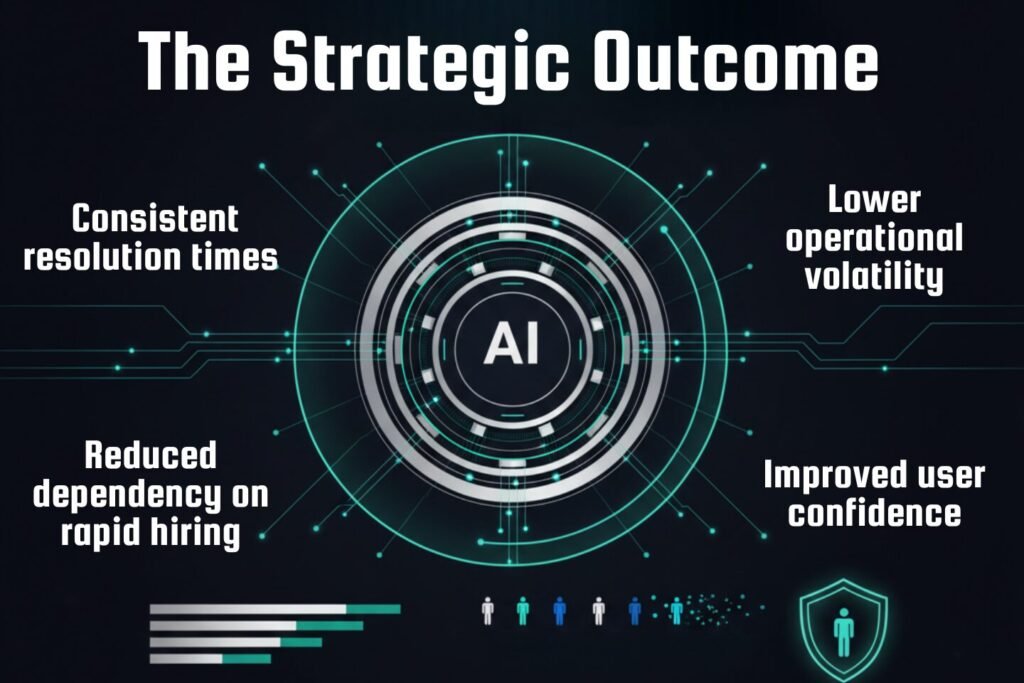
The real power of conversational AI lies in its ability to separate growth from operational expansion.
In traditional models without conversational AI, growth follows a predictable pattern: as user numbers increase, support queries rise. As queries increase, companies must expand headcount. As headcount expands, operational costs climb.
With conversational AI in fintech platforms, that equation changes. When user growth occurs, the AI system absorbs the additional demand. As volume increases, automation handles repetitive interactions, allowing operational costs to remain stable instead of rising proportionally.
Business Impact of Conversational AI in Fintech
When used correctly in fintech platforms, conversational AI systems offer:
- Faster resolution time
- Lower support costs
- Reduced escalation rates
- Improved customer confidence
- Higher transaction frequency
- Stronger retention metrics
This is because, in fintech, confidence is a direct driver of usage. Conversational AI eliminates uncertainty at scale.
Why Conversational AI Is Becoming Fintech Infrastructure
Fintech is a rapidly evolving industry. With regulations, fraud detection, and real-time transactions, fintech is becoming increasingly complex. Conversational AI is no longer a beta feature integrated into support solutions.
It is becoming:
- Core digital infrastructure
- A stabilizing influence in periods of transaction surges
- A trust-preserving solution
- A scalability facilitator
Fintech platforms that recognize Conversational AI as infrastructure are becoming scalable. Fintech platforms that recognize Conversational AI as a chatbot are becoming volatile.
The Strategic Insight
Fintech’s future AI-powered customer support is not about replacing humans; it is about intelligent load balancing. Conversational AI handles scale and repetition; human agents handle nuance and complexity. This is what digital resilience is all about.
Conclusion
Conversational AI is powering millions of digital transactions every day in fintech. It is a behind-the-scenes solution that stabilizes fintech platforms, reduces volatility, and maintains customer trust in real-time. Fintech is a high-volume industry, and scalability without intelligent AI is not sustainable. Conversational AI is not a choice; it is a necessity.
FAQ's
Conversational AI in fintech is an AI-powered customer interaction system that uses Natural Language Processing (NLP), intent recognition, and backend data integration to automate transaction-related queries. It enables digital payment platforms to provide real-time, context-aware support without relying entirely on human agents.
Conversational AI benefits digital payment platforms by automating high-volume customer queries, reducing escalation rates, and accelerating resolution times. It improves operational efficiency, stabilizes support performance during transaction spikes, and enhances overall customer experience in real-time financial environments.
Traditional chatbots rely on rule-based scripts and predefined decision trees. Conversational AI, however, uses advanced NLP, contextual memory, and backend integrations to understand user intent dynamically and provide intelligent, personalized responses instead of static replies.
Yes. Enterprise-grade Conversational AI systems are built to handle millions of concurrent interactions daily. These systems operate continuously, process natural language in real time, and scale without performance degradation, making them ideal for high-volume fintech platforms.
Conversational AI is essential for fintech platforms because it allows them to scale customer support without proportionally increasing operational costs. It decouples user growth from headcount growth, ensuring stability during peak transaction periods and maintaining consistent service quality.
Yes, when implemented correctly, Conversational AI systems comply with financial security standards. They integrate encrypted backend connections, authentication layers, and regulatory compliance mechanisms to protect sensitive transaction data.
Conversational AI increases customer trust by delivering instant, accurate, and context-aware responses during financial transactions. By reducing uncertainty and wait times, it strengthens user confidence in digital payment systems.
Conversational AI addresses common fintech challenges such as support overload, multilingual interaction complexity, slow resolution times, repetitive query management, and operational volatility during transaction surges.
Yes. Conversational AI is becoming foundational infrastructure for scalable AI customer support across fintech, banking, telecom, and digital commerce platforms, enabling sustainable growth and operational resilience.