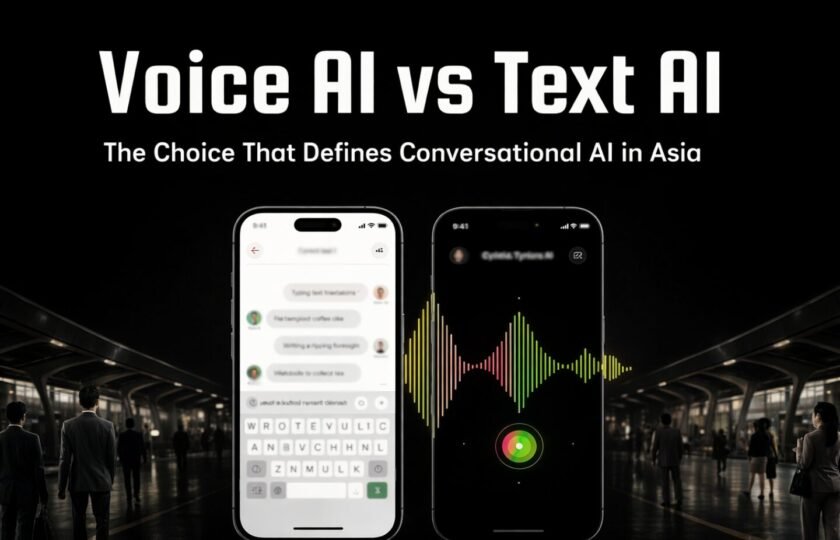
Voice AI vs Text AI: The Choice That Will Define Conversational AI in Asia
 by
by 
If Voice AI seems more natural, why do so many prefer Text AI? And if Text AI has better scalability, then why are more companies playing with voice-first experiences?
Across Asia, organizations are finding that this Voice AI vs Text AI choice is way more complicated and much more impactful than it seems at first glance. In Asia’s many languages and mobile-first world, the wrong conversational AI choice does not just lower engagement. It creates friction, confusion, and abandonment, often without companies knowing why.
That is the reason the Voice AI versus Text AI decision is much more important than most organizations think.
Why Conversational AI Decisions Matter More in Asia
Asia is not one market; it is a collection of many languages, cultures, and digital behaviors. Implementing conversational AI without understanding that complexity often leads to underperforming systems and wasted investment. Organizations choosing between Voice AI and Text AI are making long-term decisions that directly impact:
- Customer trust
- Accessibility
- Workforce productivity
- Scalability of digital transformation initiatives
For Asia, there is no success in conversational AI based on picking the trendiest interface; it must be about picking the modality that aligns with real user behaviour and future-ready AI skills.
Voice AI: Where Conversational AI Feels Most Natural
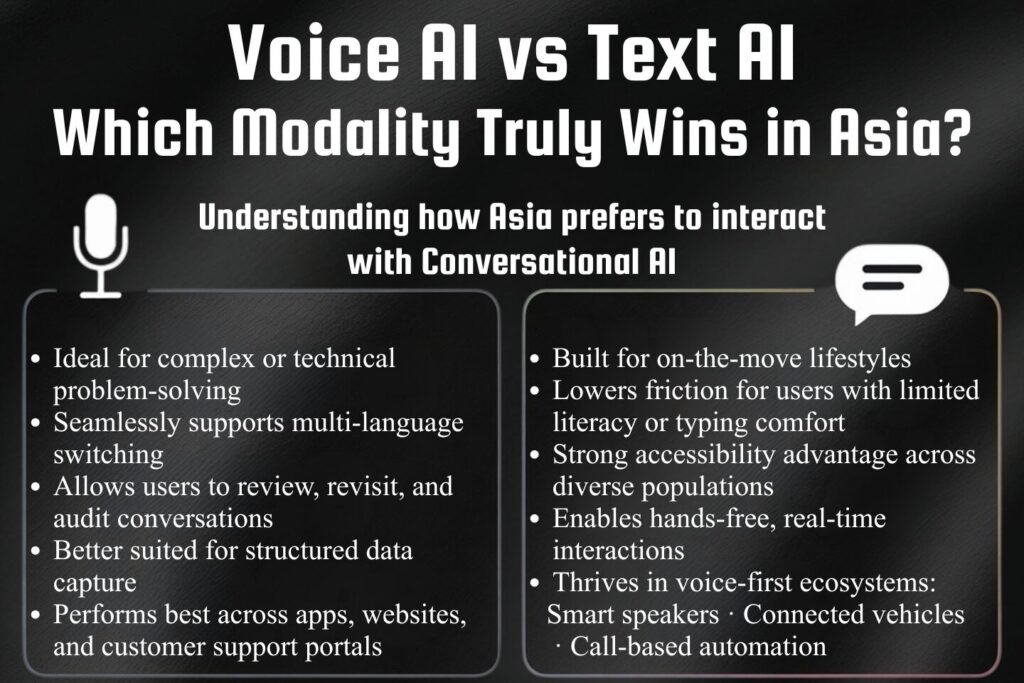
Voice AI enables hands-free, intuitive interaction and plays a powerful role in specific Asian use cases. In mobile-first markets and environments where literacy or accessibility is a concern, voice-driven conversational AI can significantly reduce friction.
Key strengths of Voice AI include:
- Natural interaction in local languages and dialects
- Accessibility for elderly or non-technical users
- Safer hands-free engagement in cars and smart devices
However, deploying Voice AI at scale requires advanced AI skills in speech recognition, accent handling, multilingual training and privacy-first design. Without these capabilities, Voice AI initiatives often fail to deliver on their promise of digital transformation.
Text AI: The Backbone of Scalable Digital Transformation
Text AI remains the most widely used form of conversational AI in Asia, despite the rise of voice interfaces.
What makes Text AI shine is that:
- It supports fast and efficient multilingual switching
- It facilitates precise communication
- It is highly efficient for handling a large number of users
If you are an organization that thrives on efficiency and digital transformation, Text AI is for you. Having strong skills in artificial intelligence, particularly natural language processing and analytics, is a must for maximizing its potential.
Why the Future Is Multimodal Conversational AI
The future of Conversational AI throughout Asia is not a simple choice between Voice AI and Text AI. It is a future with multimodal Conversational AI.
Top organizations today are combining:
- Voice AI for accessibility and natural interaction
- Text AI for structure, scale, and analytics
This hybrid approach enables conversational AI systems to adjust to user context, language, and preference, which is a major catalyst for digital transformation. Developing these systems demands high-level AI knowledge, cross-disciplinary collaboration, and learning.
How Asia Is Preparing for the Next Phase of Conversational AI
Asia’s governments, businesses, and learning institutions are investing in AI training programs, innovation centres, and learning initiatives. However, these centres are only a starting point.
Industry-led events like the Conversational AI & Customer Experience Summit Asia are critical in facilitating the following:
- Translating theory to practice in the field of conversational AI
- Showcasing success stories of Voice AI and Text AI implementations
- Supporting professionals in acquiring future-proof AI knowledge
These events will guarantee that Asia has an AI-aware workforce, but more importantly, an AI-capable workforce.
What This Means for Professionals and Businesses
For professionals, understanding the concept of conversational AI is no longer a choice. It will influence the relevance of professionals in Asia’s digital economy.
For businesses, the success of conversational AI will depend on investing in people as much as investing in technology.
Conclusion
Asia’s digital transformation in the field of conversational AI is a work in progress. The competitive advantage will be about selecting between Voice AI or Text AI.
As conversational AI becomes an integral part of our everyday experiences, it is expected that organizations and professionals who are committed to learning, adaptability, and strategic thinking, with support from platforms such as the Conversational AI & Customer Experience Summit Asia, will define the digital transformation landscape in Asia.
FAQ's
Voice AI allows users to interact using their voice, whereas text AI depends on typed interactions. Both contribute to fluid conversations; however, a voice-driven assistant should be used in experiences where users want more of a natural interaction without hands-on work, while text-driven responses often allow for increased accuracy and structure in conversational AI.
There are many languages and many dialects in Asia. Multilingual AI is essential to capturing dialects, modifications in tone, and code-mixed conversations. In many instances, Multilingual AI also makes it possible for organizations to provide an inclusive conversational experience supported by AI, which reflects real life conversations that users encounter daily.
Yes! Voice assistants can help remove barriers to access for those who may have trouble reading or typing, especially in rural or underserved communities. Voice assistants create conversational AI interactions that are more inclusive but also usable across a demographic group.
Accent differences, ambient noise, variability in pronunciations and data privacy expectations all can affect voice AI performance. These challenges all point toward constantly needing to tune models and updating AI to enhance accuracy and trust.
Yes. Many major companies in Asia have leveraged AI innovation to build hybrid systems where a voice assistant is enhanced with a text bot. This works well and delivers a more adaptive conversational experience based on the context and user behavior.
It may take more data to train your conversational AI but with cloud based services and opensource, the costs have certainly reduced. This is an area that can lead to significant ROI as you are able to reach more people and better the output of the conversations your AI engages in.
It is vital that any voice system applies strong protocols for handling audio data securely and ethically. Encryption, user consent and clear policies augment a trusted, compliant conversational experience design.
The future of conversational AI in Asia will be multimodal. It will be commonplace is the coexistence of a voice assistant alongside a text bot as part of a flexible, intelligent framework built upon iterative AI evolution.
Employ narrow pilots, such as customer support lines or some smart device integration, where multilingual AI support is available, using real customer data, to develop the system and deliver a robust conversational experience.