AI Skills in Asia Every Future-Ready Professional Should Learn
 by
by 
Asia is not facing a lack of technology.
It is facing a critical AI skills gap.
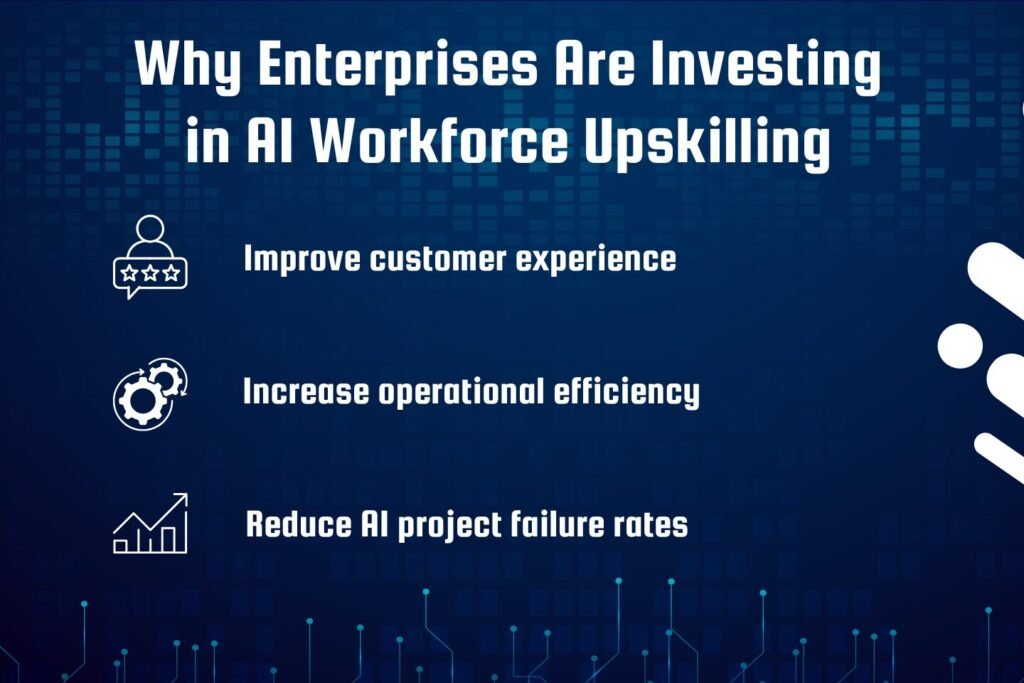
Organizations throughout the region are implementing conversational AI systems to handle customer support tasks while delivering personalized services and expanding their business operations. Enterprises face an unyielding challenge because they invested heavily in digital transformation, but their AI workforce cannot produce actual value.
Organizations require AI expertise and operational experience to execute their plans effectively. The gap between AI adoption and execution has become one of the main obstacles that businesses face when they try to expand their operations in Asia.
Why Asia’s AI Workforce Determines the Success of Digital Transformation
Asia is at the forefront of mobile adoption, fintech innovation, and digital payments. But digital transformation is no longer a technology adoption issue; it’s a workforce capability issue.
The future-ready AI workforce needs to know how conversational AI is connected to business processes, customer experience, and decision-making. Without this knowledge, AI projects will falter, customer journeys will fail, and investments will not scale.
Companies that focus on AI skills development will continue to outperform companies that view AI as a plug-and-play solution.
Core AI Skills for the Next Generation
By 2026, building a competitive AI workforce will require far more than basic AI awareness. As conversational AI becomes deeply embedded into enterprise workflows and digital transformation matures, organizations will demand advanced, cross-functional AI skills that combine technology, governance, and business impact.
Below are the most critical AI skills required in 2026 and beyond.
1. Data Literacy: The Foundation of Conversational AI
Developing AI capabilities in conversational platforms requires an understanding of how AI produces data; Workers, Regardless of Job Type (i.e., sales, marketing, etc.) must be able to interpret the results of AI, make predictions based on the available data and, through AI’s pattern recognition capabilities, align with the direction of the business (towards becoming digitally transformed). The Importance of Data Literacy as an AI Capability. It is no longer optional, but a necessary skill for all workers.
2. Conversational AI and Automation Development
As with many forms of technological development, conversational bot (aka chatbots or conversational AIs) design is one of the most dominant factors driving digital transformation. In Asia, there is currently a great demand for professionals with experience developing chatbots/conversational AIs and building virtual assistant applications. The AI skills developed by creating these bots help companies to….. Automate Repetitive Tasks. Improve Customer Satisfaction. Scale service delivery better. Ultimately, an AI-equipped workforce will allow companies to develop solutions to enhance their jobs, not eliminate them, through automation.
3. Prompt Engineering and Generative AI Skills
Generative models are evolving; Prompt Engineering will be one of the essential AI skills used as a component of Generative Models. The work done by Prompt Engineers will guide Generative Models to produce quality and relevant business-aligned responses in the context of Conversational Agents. This role will involve a combination of creative thinking and technical knowledge to be positioned at the intersection of IT (technology) and the business applications of AI through Conversational Agents (bots).
4. Responsible AI, Governance, and Security
AI that works well is fully supported by trust. Therefore, ethical, legal, and safety considerations when deploying AI are just as important as technical considerations, since they form the foundation for successful, scalable conversational AI solutions.
5. AI Product Thinking and Business Integration
Product thinking is one of the most underdeveloped AI skill sets. By 2026, AI professionals will be required to not only know how to build AI solutions, but also to understand how AI delivers value.
They need to do the following:
- Translate business challenges into useful AI applications
- Determine ROI for conversational AI implementations
- Align AI initiatives with customer experience objectives.
An AI workforce that possesses strong product-thinking skills will create a true impact rather than simply experiment with their technology.
6. Human–AI Collaboration and Workflow Design
The future of AI work will be hybrid – a mix of human and AI work. These new work environments will require AI professionals to develop workflows where conversational AI assists employees rather than replacing them entirely.
The key skills that will need to be developed for this type of workflow design include:
- Human-in-the-loop design
- Exception handling
- Decision escalation
These skills will ensure both increased productivity and accountability as businesses transition to a more digital world.
Soft Skills Are Equally Important
AI encompasses much more than computer programming. Organizations will depend on human skills such as
- Creative thinking
- Problem solving
- Emotional intelligence
- Communication skills
- Collaboration across functions
These human skills, with the augmentation of technical talent, will enable organisations to innovate responsibly and sustainably.
How Asia Is Training Its AI Workforce
Universities and organizations around the region are creating new AI training programs, research hubs, and learning academies. Governments are providing scholarships, incubators, and public-private partnerships to support digital transformation. Much of this energy is a result of industry and education working together rather than separately.
This is also why events like the Conversational AI & Customer Experience Summit Asia are the best tech events in Asia, focused on learning in the real world. At tech conference Asia, experts share real-world case studies, hands-on AI demos, and tools that businesses can use immediately. It pushes the workforce far beyond theory and into real implementation.
The Road Ahead
As automation grows, an AI workforce will empower employers and nations. Businesses that invest in training will innovate bolder, scale smarter, and enhance customer experiences that leverage conversational AI. Asia leads in mobile and digital payments, and with the right skills, it could be the leader in AI-enabled solutions.
Conclusion
The future workforce in Asia will enter work environments that have AI integrated into every aspect of the business process. Creating an AI workforce refers to more than coding, it means developing creative thinkers, responsible innovators and confident problem-solvers. With capable learning ecosystems and visionary organizations, the future of AI will be in Asia.
FAQ's
Asia is undergoing a large-scale digital change, and a solid AI workforce enables businesses to innovate at speed, automate processes and improve customer experience. With conversational AI and automation becoming commonplace, businesses will need to employ experts who can design and deploy intelligent systems.
The most competitive AI skills currently are machine learning, cyber security, prompt engineering and conversational AI development. Any business hiring for the AI workforce will expect technical capability, but also problem-solving and communication skills for use case implementations .
With conversational AI handling routine and mundane work in the future, job roles will become increasingly focused on strategic, creative or human decision-making. Rather than replacing employees, digital transformation will create hybrid roles for humans and AI.
Banking, retail, healthcare, logistics, telecommunications, and manufacturing are expanding their AI workforce. These sectors use automation and conversational AI to boost services, reduce costs, and enhance customer relationships.
Students can obtain experience with AI skill development through an online course, internship, hackathon or through an AI technology summit that aims to develop AI skills/training. Students can expect to gain practical AI experience by participating in one of the premier tech events in Asia that is focused on creating AI leaders in the field.
Definitely. Regardless of how strong a person’s AI skill set is, businesses want innovative thinking, empathy, and good interpersonal skills. A successful AI-powered workforce puts together the technology with the logic of a human being, and this human element is essential to build ethical and responsible AI.
Conversational AI platforms are able to support regional languages and voice input, to provide direct access to digitally enabled services, against a backdrop of varying literacy and technology literacy.
Absolutely. Asia’s rapid digital transformation progress, mobile-first population, and easy access create a strong innovation ecosystem for conversational AI solutions. Many industry leaders would now agree that CACES Asia is the best tech events in Asia that showcase this rapid development.
AI-related products only work if the AI workforce is trained to deploy AI responsibly. Training maintains data security, ethical determination making, and reliable conversational AI use for organizations.
It is the best tech event in Asia because of live demonstrations, hands-on workshop participation, and comprehensive sharing of extensive knowledge. The CACES Asia connects established organizations, start-ups, and learners tied to the practical adoption of conversational AI, and actual results.