Something Big Is Happening in Indonesia, And AI Leaders Are Watching
 by
by 
There’s a quiet shift happening in Indonesia right now.
Not the kind that shows up in headlines.
Not the kind that gets announced in product launches.
But the kind that changes how millions of people interact with businesses every single day.
While most companies are still figuring out where conversational AI fits into their strategy, Indonesia has already moved past that question. Here, conversational AI isn’t being tested. It’s being used at scale, under pressure, in real customer environments where expectations are high, and patience is low.
And that’s exactly why the global tech community is paying attention to it.
In Indonesia, Conversational AI Isn’t a Feature - It’s the Experience
In many markets, conversational AI still lives on the surface. It appears as a chatbot, answers a few questions, and disappears the moment complexity shows up.
But in Indonesia, something different happened. The conversation became an experience.
The conversational experience is no longer a layer added on top of apps or websites. It has quietly become the first interaction, the fastest resolution, and often the only interface users need.
This shift didn’t happen because companies wanted to innovate. It happened because they had no choice. When millions of users are interacting daily, ordering, paying, and resolving issues, there’s no room for friction. A weak conversational experience doesn’t just fail. It gets replaced instantly.
So companies adapted. And in doing so, they pushed conversational AI far beyond what most markets have seen.
Why Indonesia Is Where Conversational AI Gets Real
Indonesia doesn’t give technology the luxury of being imperfect. Every interaction carries urgency. Every delay is visible. Every misunderstanding breaks trust. This distinguishes how Conversational AI will operate within Indonesian culture.
Conversational AI. is not limited to an ideal, pre-set condition. Conversational AI evolves within the complexity of everyday interactions. Conversational AI’s primary role is to support external communication for Indonesian companies such as Gojek or Tokopedia through ongoing conversations that involve fast (rapid), messy (unstructured), and human-to-human (non-linear dimensions of language). Conversational AI does not use a script. Instead, Conversational AI operates as an adaptive learning mechanism through real-time response to events.
The advancement of technology is where the most dramatic change in the future resides. When Conversational A.I. becomes applicable in these types of environments, it will no longer be an experiment. Instead, it will evolve to be the fundamental foundation that enables the future progress of technology.
The Moment Conversational Experience Became the Standard
At some point in your life, the way you expect things to be will change. Such a point had already occurred within Indonesia as Indonesian users who had enjoyed seamless conversational experiences were now expecting all other places to have similar types of environments to which they were accustomed. This is how an industry sets its standards; it does not do so by way of formal announcement but rather through constant exposure. This example reflects that the deployment of a Conversation AI (artificial intelligence) across many businesses has gone beyond being simply a regional success for Indonesia, and now serves to be a model for large-scale conversational experience implementations everywhere.
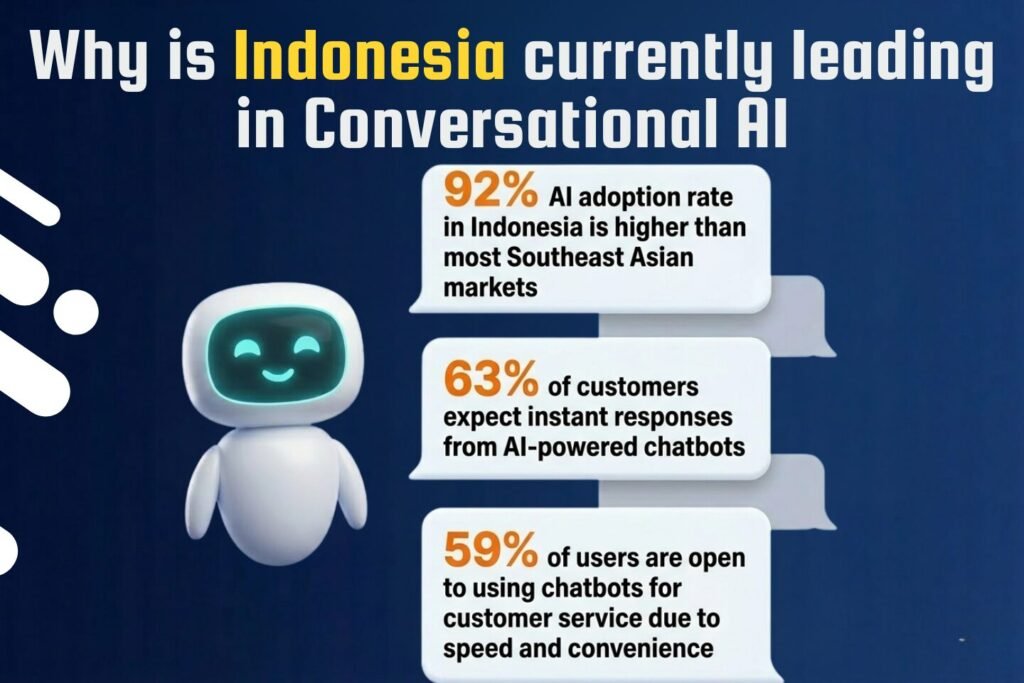
Why Leaders Are Paying Attention Now
The most fascinating aspect of this change is not the tech, but the behaviours around it. Leaders stopped debating whether conversational AIs are significant, as that decision is established. Rather, leaders are attempting to grasp more practical issues like:
How do I develop a working solution via conversational AI when there are real consequences?
How do I build a conversational experience that will not collapse when it is under stress?
How can something develop when it was never designed to be static?
This is why there continues to be an increasing attraction to both the conversational AI Summit and the Customer Experience Summit, since the solution does not exist in a theoretical environment but rather in actual global markets, such as Indonesia.
The Real Risk No One Talks About
A division is forming. One set of organisations continues to view dimensions of Conversational AI as just features of their business. While another group has completed an entire Conversational experience focused on Conversational AI as they continue developing an AI strategy and implementation in the rest of their business (with most of these businesses being in Indonesia).
The separation from each category or group is expanding and widely recognised. Indonesia has positioned itself (based upon the development of these businesses) on the latter.
When it comes to conducting business in Conversational AI, companies must evaluate their experiences and apply what they’ve learned in the Continent as an organisation.
And that’s why interest in conversational AI summits and customer experience summits is rising in many countries of Asia, like Indonesia, Singapore, Malaysia, etc.
Conclusion: Indonesia Isn’t Being Watched - It’s Being Studied
What’s happening in Indonesia is not a trend. It’s a shift in how digital businesses are being experienced. Conversational AI in Indonesia has moved beyond experimentation. It is now shaping how conversational experience is designed, delivered, and expected.
And the reason everyone is watching isn’t curiosity. It’s an urgency.
Because the companies that understand this shift early are the ones that won’t have to catch up later.
FAQ's
Because conversational AI in Indonesia is no longer experimental—it’s operating at real-world scale. Companies are delivering a seamless conversational experience across millions of interactions daily, which makes Indonesia one of the most important markets for understanding how conversational AI actually works in production environments.
Unlike other regions where conversational AI is still evolving, conversational AI in Indonesia is being tested under pressure. The need to deliver a consistent conversational experience across diverse users, languages, and real-time interactions forces companies to build smarter and more scalable AI systems.
Conversational AI improves conversational experience by enabling faster, context-aware, and more natural interactions. Instead of navigating apps or waiting for support, users engage in real-time conversations, making the conversational experience smoother, more intuitive, and highly efficient.
The demand for conversational AI summits is increasing because businesses want real insights into how conversational AI is being implemented at scale. Leaders are looking to learn how to improve conversational experience using proven strategies from markets like Indonesia.
Businesses can learn how to design scalable conversational AI systems that deliver a reliable conversational experience even under high demand. Indonesia shows how conversational AI can move beyond basic automation into a core business infrastructure.
Conversational AI plays a critical role in improving conversational experience, which directly impacts overall customer experience. This is why interest in customer experience summit is growing, as companies look to understand how AI-driven conversations can enhance engagement, retention, and satisfaction.
Anyone involved in building or improving conversational AI or conversational experience should consider buying conversational AI summit tickets. This includes CX leaders, product teams, AI engineers, and enterprise decision-makers.
Industries like fintech, telecom, e-commerce, and travel are rapidly adopting conversational AI to improve conversational experience. These sectors rely heavily on real-time interactions, making conversational AI essential.
Because customer expectations have changed. A strong conversational experience, powered by conversational AI, is now a competitive advantage. Businesses that delay adoption risk are falling behind. The businesses want to learn and adopt conversational AI and Customer Experience strategies and because of this interest in Conversational AI & Customer experience summit continues to grow.