Reliance Jio Didn’t Implement Voice AI, It Rebuilt Customer Support at Scale
 by
by 
What if millions of customers could get instant support without apps, menus, or literacy requirements?
What if there were no more waiting on hold?
This was the dilemma faced by Reliance Jio to support its hundreds of millions of customers across rural India. Call centres were not feasible, and text-based chatbots were not an option. Human support alone was not sufficient. Reliance Jio took a bold turn. Rather than expecting users to learn to use technology, Reliance Jio decided to build technology that could speak the user’s language. This is how voice-based conversational AI came to be used for rural customer support by Jio, and this is why it’s one of the most significant examples of AI adoption in emerging markets. This was Reliance Jio’s reality. And here’s the uncomfortable truth:
Most customer support systems fail at this scale.
Reliance Jio did not.
The Real Challenge: Supporting Rural India at National Scale
Rural customer support is not a “smaller version” of urban CX.
The challenges that Jio had to overcome were:
- Multiple regional languages and dialects
- Low literacy levels and unfamiliarity with smartphones
- Inconsistent internet connectivity
- High volumes of calls in case of network or billing problems
The traditional IVR solution was not effective because it was inflexible and menu-based. The traditional chatbots were not effective because the most popular interface is voice. What Jio needed was something completely different.
Why Text Chatbots Failed Before They Even Started
On paper, the chatbots seemed to have potential. In reality:
- Many users preferred speaking over typing
- Language switching broke intent recognition
- Low-end devices struggled with chat interfaces
Text-based AI assumed users would adjust. But Jio discovered something fundamental: In developing markets, technology must fit the human, not the other way around. This insight changed everything.
The Strategic Shift: Voice First, Not Voice as an Add-On
Jio didn’t “experiment” with voice AI. They rebuilt customer support around it. Instead of:
“Press 1 for English. Press 2 for Hindi.”
Users could simply speak.
Naturally.
Casually.
In their own language.
No scripts. No rigid flows. No guessing.
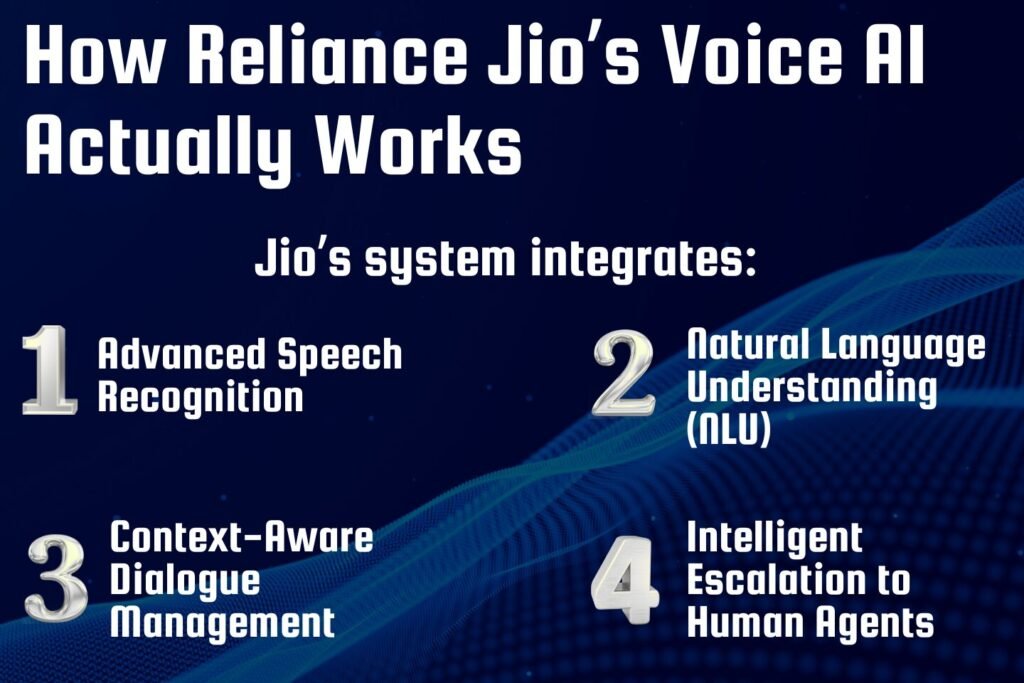
What Made Jio’s Voice AI Actually Work
Jio didn’t “experiment” with voice AI. They rebuilt customer support around it. Instead of:
“Press 1 for English. Press 2 for Hindi.”
Users could simply speak.
Naturally.
Casually.
In their own language.
No scripts. No rigid flows. No guessing.
The Breakthrough Moment: When Scale Stopped Being a Problem
This is where things flipped. Voice AI handled:
- Balance checks
- Plan explanations
- Network issue diagnostics
- Routine troubleshooting
Voice AI handled repetitive and common problems, while Human Agents focused on real and complex problems. After Voice AI went live, everything shifted.
- Call volumes stabilized.
- Resolution times shrank.
- Customer frustration dropped.
Not by a few percentage points. By a game-changing margin.
Why This Was Bigger Than Customer Support
Jio didn’t just fix CX. They built a new operating model. A world where:
- Voice is the new interface
- AI replaces humans, not volume
- Language is a strength, not a limitation
This was not an automation. It was an augmentation at scale.
Why Other Industries Are Watching Closely
This is not a telco-specific model. It is already shaping:
- Banking services in rural areas
- Government helplines
- Healthcare scheduling
- Utility services
Any scenario where millions of users require assistance without friction, voice-based AI is an inevitability.
The Real Lesson Most Companies Miss
This story isn’t about AI. This story is about understanding human behaviour. Human beings talk before they type.
People speak before they type.
People explain before they click.
People want to be understood, not processed.
Jio created an AI that understood human behaviour.
Final Thought: This Is the Future of Scaled CX
Voice-driven conversational AI isn’t emerging anymore.
It’s already proven.
Reliance Jio proved that when you create AI for humans, customer experience doesn’t just improve, it transforms.
Reliance Jio didn’t win by deploying more agents, adding more menus, or scaling traditional systems. It won by eliminating friction. Instead of forcing millions of users to adapt to technology, Jio built technology that adapted to humans.
FAQ's
Jio's voice-driven chatbots are AI-powered Voice Bots that let users speak naturally and receive instant support for common queries.
It enhances customer support by simplifying the interactions, reducing waiting time, and offering accurate solutions through natural conversations.
The different problems that the customers can solve by using the voice bot are plan upgrades, recharge issues, troubleshooting networks, data usage checks, and account-related queries.
Conversational AI looks at the user's mood, linguistic patterns, and the overall context to figure out the user's intent and to give the appropriate response.
Yes, the voice-driven chatbot runs 24/7 for seamless Digital Support
Yes, the chatbot follows Jio's standards for privacy and authentication.
It feels more natural to speak than type for a large share of users, hence the voice-based customer service is more effective.
In the future, you might expect deeper personalization, better language understanding, and wider integration across the Jio ecosystem.