Singtel’s AI Assistant Handled 70,000 Customer Cases in Six Weeks. The Bigger Story Is What Happened Next
 by
by 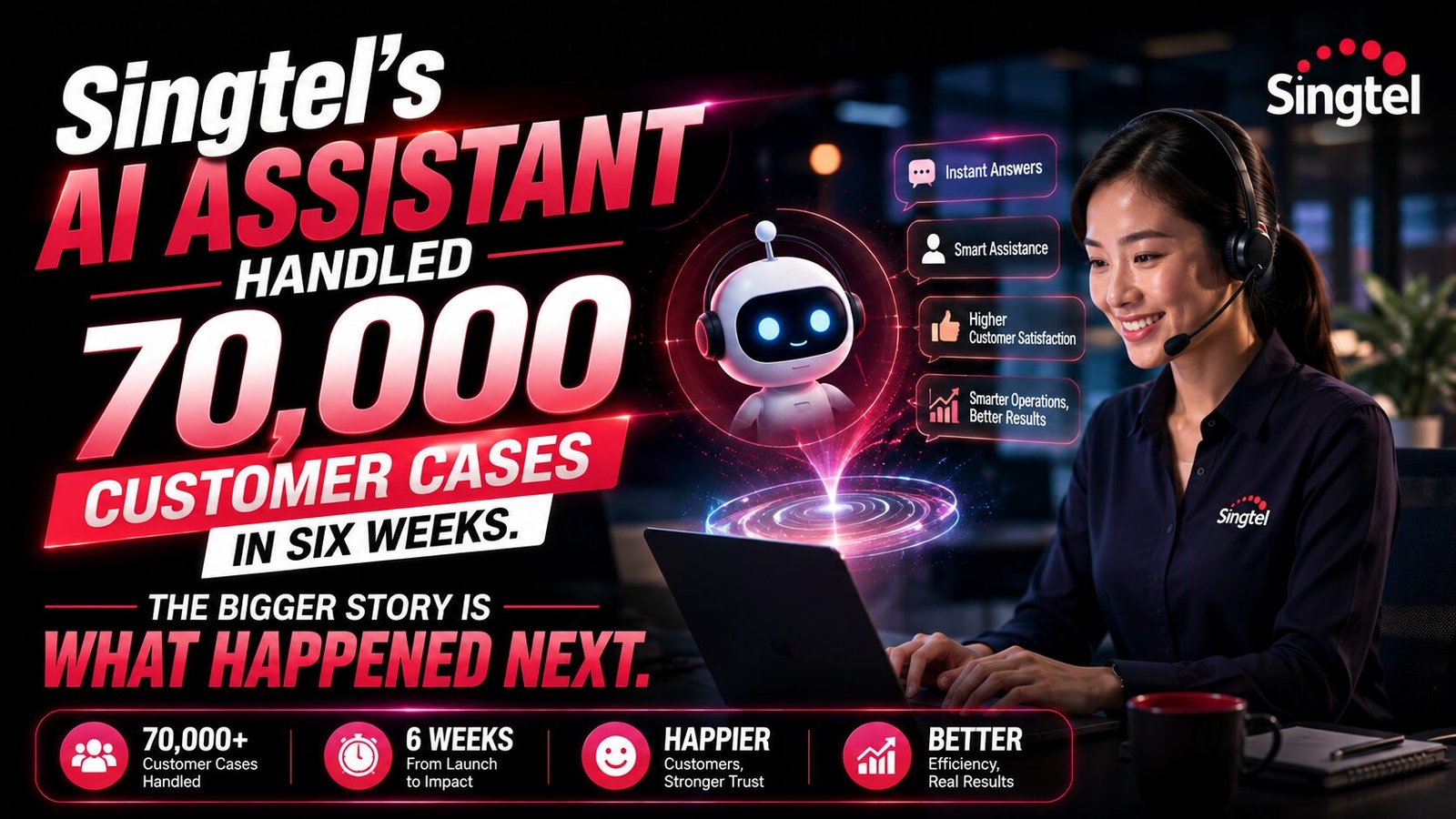
A customer has a roaming problem hours before a flight. Another cannot get their home connection working. Someone else wants to activate a service but does not want to wait in a support queue.
For a telecom company, these are ordinary requests. At scale, they become an extraordinary customer experience problem. Singtel’s answer is becoming much more interesting than another chatbot story.
In March 2026, Singtel disclosed that its AI assistant, Shirley, had handled more than 70,000 customer cases during its first six weeks after the launch of new agentic AI capabilities. Even more striking, 73% of mobile and home troubleshooting cases were resolved without a Customer Care officer, while 76% of roaming sign-up requests were completed without one. More than 200 roaming add-ons were also purchased independently through the experience.
(Source: Singtel, March 4, 2026)
Those numbers reveal the real transformation. Conversational AI in telecom is moving beyond answering questions. It is beginning to resolve problems, complete transactions and decide when human expertise should enter the conversation.
That distinction matters. For years, the ambition behind AI Customer Support was simple: automate more conversations. Singtel’s latest approach suggests a more valuable target:
Resolve more customer intent.
And that could fundamentally change how telecom companies measure customer experience.
Singtel's AI Story Is No Longer About a Chatbot
The old chatbot model was built around answers. A customer asks a question. The bot recognizes an intent. The system retrieves information. The customer receives a response.
Useful, but limited. Singtel is now pushing beyond that model.
In March 2026, Singtel Group announced a strategic partnership with Sierra to introduce agentic AI capabilities across chat and voice. The initial pilot began in late January within Singtel Singapore’s customer-care ecosystem, including its existing AI assistant, Shirley.
(Source: Singtel, March 4, 2026)
The implementation went live in less than 10 weeks.
(Source: Singtel, March 4, 2026)
The important word here is not “AI.” It is agentic.
The objective is to give customers a system capable of doing more than explaining what needs to happen. Singtel says the technology can verify customer details, provide relevant product and service information, help customers independently resolve requests and support transactions through its virtual customer-service platforms.
(Source: Singtel, March 4, 2026)
That changes the value equation for Conversational AI. A chatbot can tell a customer how to activate roaming. An AI agent can potentially help the customer complete the roaming request. One provides information. The other moves the customer closer to resolution. For customer experience leaders, that difference is enormous.
The Numbers Behind Singtel's AI Customer Support Shift
Singtel’s early disclosed results provide something that many enterprise AI case studies lack: measurable operational evidence.
More than 70,000 customer cases handled in six weeks
(Source: Singtel, March 2026)
The cases included high-volume requests involving mobile issues and roaming services.
73% of mobile and home troubleshooting cases resolved without a Customer Care officer
(Source: Singtel, March 2026)
This is particularly significant because troubleshooting moves Conversational AI beyond simple FAQ automation.
76% of roaming sign-up requests completed without a Customer Care officer
(Source: Singtel, March 2026)
Again, the important word is “completed.” Completion is a stronger business outcome than conversation volume.
More than 200 roaming add-ons purchased independently
(Source: Singtel, March 2026)
This demonstrates another important transition: conversational systems are beginning to participate directly in transactional customer journeys. The numbers are early results, not evidence that every Singtel customer journey can or should become autonomous. But they provide a much stronger indication of where telecom AI is heading.
The future KPI may not be:
How many conversations did the chatbot handle?
It may increasingly become:
How many customer intentions did the system successfully resolve?
The Metric Telecom Leaders Should Start Watching: Resolution Without Friction
For years, contact centres have measured metrics such as average handling time, first-contact resolution, call volume and cost per interaction. Those metrics still matter. But agentic AI introduces another layer. Imagine two telecom assistants.
Assistant A handles 1 million conversations.
Assistant B handles 600,000 conversations but successfully resolves a significantly higher percentage of customer intentions.
Which system created more value?
Conversation volume alone cannot answer that question. This is why Singtel’s reported 73% troubleshooting resolution rate and 76% roaming sign-up completion rate are more strategically interesting than the headline number of 70,000 cases.
(Source: Singtel, March 2026)
They point toward an outcome-based model of AI Customer Support. The question is shifting from:
“Did AI respond?”
to:
“Did the customer actually get what they came for?”
That is the metric enterprise CX teams should be watching.
Why Singlish Matters More Than It Sounds
One of the most revealing details in Singtel’s announcement has nothing to do with transaction volume. Shirley is designed to understand local expressions and colloquialisms, including Singlish.
(Source: Singtel, March 2026)
This sounds like a language feature. It is actually a customer experience strategy. Traditional conversational systems often force customers to adapt their language to the machine. People simplify sentences. They repeat themselves. They search for the “correct” keyword. They restructure natural questions because the system cannot understand how they actually speak.
That creates conversational friction.
For Conversational AI in Southeast Asia, language intelligence is especially important because markets across the region contain enormous linguistic, cultural and behavioral variation. A truly effective Conversational Experience cannot simply be technically multilingual. It needs to understand how customers naturally communicate. Singtel’s Singlish capability therefore illustrates a broader principle:
The best AI does not teach customers how to talk to technology. It teaches technology how customers already talk.
The Most Important Part of Singtel's Model May Be What AI Does Not Handle
The race toward autonomous customer experience creates an obvious temptation:
Automate everything possible. That is not necessarily a good customer experience.
Singtel says its virtual customer-service platforms are designed so interactions remain accurate, secure and subject to human oversight.
(Source: Singtel, March 2026)
That last part matters. A telecom customer asking about a roaming add-on represents a very different interaction from a customer dealing with a complex billing dispute, service failure, vulnerable situation or unusual account problem.
The right operating model therefore is not:
AI versus humans.
It is:
AI for predictable resolution
Routine, repeatable and sufficiently understood requests can increasingly be handled through AI Customer Support.
AI-assisted humans for complexity
AI can retrieve information, summarize conversations and provide context so Customer Care officers spend less time searching and more time solving.
Human judgment for exceptions
Complex, sensitive, ambiguous and high-risk situations need clear escalation paths. This is where many Conversational AI strategies fail. They optimize automation rate instead of customer outcome. If customers have to fight the AI to reach a person, automation has not removed friction. It has simply relocated it.
Singtel Is Building AI Around a Much Larger Corporate Strategy
Shirley should not be viewed as an isolated chatbot project. Singtel’s FY2026 Annual Report describes the Group’s broader ambition as becoming an AI-led connectivity, digital infrastructure and technology services group. It frames its AI strategy around three roles: Adopter, Provider and Enabler.
(Source: Singtel Annual Report FY2026)
As an Adopter, Singtel applies AI internally to improve efficiency, customer experience and value creation. As a Provider, the Group develops and commercializes AI solutions. As an Enabler, it provides connectivity, infrastructure and platforms supporting AI adoption at scale. That context changes how Shirley should be understood. This is not simply a contact-centre optimization experiment. It sits inside a broader organizational AI strategy.
Singtel’s FY2025 reporting also stated that its regional footprint collectively served a mobile customer base exceeding 800 million across its businesses and regional associates, with reach spanning 20 countries across Asia, Australia and Africa.
(Source: Singtel Annual Report FY2025)
At that scale, even small improvements in how AI handles customer interactions can have meaningful operational implications.
There Is Another Data Point CX Leaders Should Not Ignore
Singtel’s broader technology ecosystem provides useful evidence for how AI can change human-agent productivity too. NCS, part of the Singtel Group, reported that a generative AI solution developed for Singapore’s Ministry of Manpower Contact Centre delivered a 12% reduction in average handling time and more than a 50% decrease in average time spent on after-call work.
(Source: NCS CEO Review, Singtel Annual Report FY2025)
This was not Shirley and should not be presented as a Singtel consumer-support result. But it demonstrates the second half of the AI Customer Support opportunity. AI can work on both sides of the conversation. On the customer side, Conversational AI can resolve routine intent.
On the employee side, AI copilots can reduce administrative effort, summarize interactions and help agents retrieve information faster. The strongest contact-centre architecture may therefore not be AI-first or human-first. It may be resolution-first. Use the combination that solves the customer’s problem with the least unnecessary effort.
The Three-Layer Telecom AI Model Other Enterprises Can Learn From
Singtel’s evolving approach points toward a useful framework for telecom leaders evaluating Conversational AI.
Layer 1: Understand
The system needs to understand what the customer actually wants, including natural language, local expressions and conversational context. If intent recognition fails, everything downstream fails.
Layer 2: Act
The AI must move beyond information retrieval. Where appropriate and authorized, it should connect with operational systems so customers can complete tasks, troubleshoot services and perform transactions. This is where agentic AI becomes materially different from traditional chatbots.
Layer 3: Escalate
The system needs to recognize when autonomous resolution is inappropriate. Human oversight is not evidence that the AI failed. Correct escalation is itself a successful AI decision. This creates a more useful enterprise KPI framework:
- Intent understood
- Action completed
- Escalation handled correctly
Those three measures tell CX leaders much more than chatbot volume ever could.
What Singtel's Results Do Not Prove Yet
Singtel’s disclosed results are promising, but they are early. The reported figures cover the first six weeks after launch and specific high-volume use cases such as troubleshooting and roaming. They do not, by themselves, establish:
(Source: Singtel, March 2026)
- Long-term customer satisfaction improvement
- Performance across every customer-service intent
- Long-term cost savings
- Accuracy across all customer demographics
- Customer preference for AI versus human assistance
- Long-term retention or revenue impact
Those outcomes require longer-term evidence. This distinction matters because enterprise AI is filled with impressive pilot metrics that do not always translate into sustainable customer experience improvement. Singtel’s next challenge is therefore not proving that agentic AI can work. It is proving that it can remain accurate, trusted and useful as the number and complexity of autonomous journeys expand.
What Telecom Leaders Should Measure Before Scaling Agentic AI
If your organization is evaluating Conversational AI, do not begin with the question:
“How much can we automate?”
Begin with five harder questions.
1. Resolution Rate
What percentage of customer intentions are genuinely resolved without requiring customers to restart the journey?
2. Completion Rate
For transactional journeys, how often does the customer successfully complete the intended action?
3. Escalation Quality
When AI cannot safely resolve an issue, how quickly and cleanly does the interaction transfer to a human?
4. Repeat Contact Rate
Does the customer return with the same problem after an apparently successful AI interaction?
5. Customer Effort
Did AI actually make the experience easier?
These metrics protect organizations from one of the biggest mistakes in Customer Experience Automation:
confusing fewer human interactions with better customer outcomes.
From Conversational AI to Agentic Customer Experience
Singtel’s evolution reflects a much larger shift taking place across enterprise customer experience. The first generation of chatbots answered FAQs. The second generation understood more natural language. Generative AI made conversations more flexible. Agentic AI is now pushing customer service toward something different:
systems that can understand, reason, access information and complete authorized actions.
That is why conversations across enterprise platforms and industry forums such as the Conversational AI & Customer Experience Summit Asia are increasingly moving beyond “Should we deploy AI?” toward much harder questions around autonomy, governance, human oversight and measurable business outcomes. The technology conversation is maturing. So should the metrics.
Final Insight: Singtel's Most Important AI Metric Is Not 70,000
The headline number is impressive. More than 70,000 cases in six weeks get attention. But it is not the most important number in Singtel’s story.
73% of selected troubleshooting cases resolved without a Customer Care officer. 76% of roaming sign-up requests completed without one. Those figures reveal what is actually changing. Conversational AI is moving from conversation automation to outcome automation.
That creates an enormous opportunity for telecom companies, but also a new responsibility. The goal cannot be to remove humans from customer service. The goal has to be removing unnecessary effort from customer service. Sometimes AI will provide the fastest route to resolution. Sometimes a human will.
The telecom companies that win this transition will be the ones intelligent enough to know the difference. And that may be the most important lesson from Singtel’s AI transformation so far.
FAQ's
Shirley is Singtel Singapore's AI customer-service assistant. In 2026, Singtel enhanced Shirley through a partnership with Sierra, adding agentic AI capabilities designed to make conversations more natural and help customers independently resolve queries and complete transactions. Source: Singtel, March 2026
Singtel reported that Shirley handled more than 70,000 customer cases in the first six weeks following the launch of its new capabilities. Source: Singtel, March 2026
In Singtel's initial reported results, 73% of mobile and home troubleshooting cases were resolved without a Customer Care officer, while 76% of roaming sign-up requests were completed without one. These are early results from selected use cases and should not be interpreted as resolution rates across all Singtel customer-service interactions. Source: Singtel, March 2026
Yes. Singtel says Shirley is designed to understand local expressions and colloquialisms, including Singlish, to create more intuitive interactions for customers in Singapore. Source: Singtel, March 2026
Traditional Conversational AI primarily focuses on understanding and responding to customer questions. Agentic AI can extend that model by taking authorized actions, accessing relevant systems and helping complete customer tasks. Singtel's 2026 implementation includes capabilities designed to support independent query resolution and transactions.
Singtel's stated model retains human oversight. Its early results show AI resolving selected routine requests independently, which allows Customer Care officers to focus on more complex and higher-value interactions. Source: Singtel, March 2026
The most important lesson is to optimize for resolution rather than automation volume. Telecom companies should measure whether AI understands customer intent, completes the required action, reduces customer effort and escalates appropriately when human judgment is needed.
Telecom support involves large volumes of repetitive but actionable requests such as troubleshooting, roaming and account services. Agentic AI can potentially connect conversation with action, allowing customers to move from asking what to do toward completing the task within the same Conversational Experience.
DBS regularly attends and participates in industry conferences and Conversational AI sessions, sharing their results, experiences, and learnings with other banks and the broader community, as well as providing their playbooks for other banks to learn from.
Singtel's AI solution has demonstrated the ability to combine the elements of AI Customer Support, Telecom AI Transformation and AI Agent Workflows into one seamless solution that substantially improves the customer's conversational experience on an enterprise scale.