Conversational AI
The Digital Foundation of Modern Interaction
The Complete, Practical Guide for Businesses
Most digital experiences no longer begin with clicks, menus, or forms. They begin with conversations.
From customer support to shopping, banking, and healthcare, conversational AI is quietly replacing traditional digital interfaces, changing how humans interact with technology at scale.
Today, conversational artificial intelligence (AI) technology is one of the most impactful forces changing how companies interact with their customers, employees, and users. Through various conversational AI solutions such as chatbots, virtual assistants, and voice-based systems, conversational AI gives machines the ability to talk, to intuitively comprehend and react to nature in a scalable way.
In this guide to conversational AI technology, we detail everything you need to know about conversational AI technology, including what it is, how it functions, which technologies drive it, the different types of conversational AI that are utilized in the market today, and how conversational AI has become the ‘new digital foundation’ for modern interactions between companies and customers.
What Is Conversational AI?
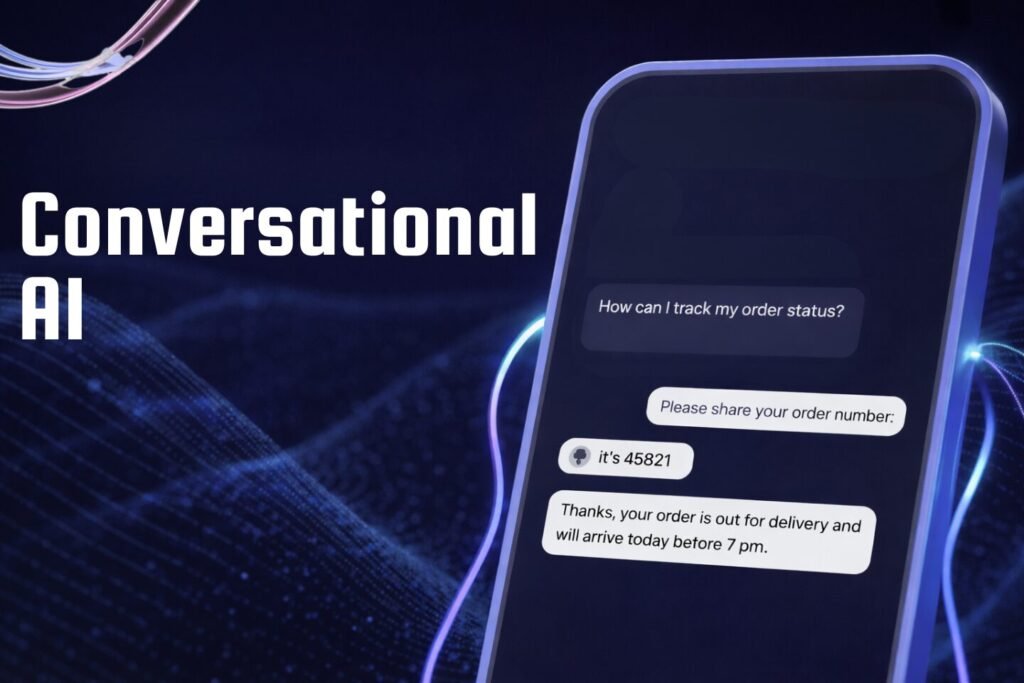
Conversational AI is defined as any technology that empowers users to communicate directly with computer systems in the same way they would communicate naturally with other people by either text or voice. The main role of conversational AI technology is to decipher user input, calculate the meaning of that input, and provide relevant responses in a timely manner.
Unlike traditional chatbots, which are designed to execute simple tasks based on pre-written scripts, conversational AI technologies incorporate machine learning and artificial intelligence to continuously learn from previous conversations and make improvements to their overall intelligence as they are used more frequently, thus enabling conversational AI systems to continually adapt to how their users typically converse with one another across multiple channels and contexts, regardless of the user’s native language or communication skills.
Use cases for conversational AI technologies are varied: chatbot technology, automated virtual agents, voice assistant technology such as Amazon’s Echo, AI messaging systems used in customer support, sales, healthcare, banking, and enterprise automation, etc.

How it Works
A continuous learning process driven by three core pillars
NLP
A Conversational AI system is formed from multiple technologies that work together through a process called continuous learning. The first step in creating a Conversational AI system is through Natural Language Processing (NLP). By using NLP, a Conversational AI system can understand how humans communicate, including sentence structure, meaning, and context.
ML
As a result of using Machine Learning (ML), the Conversational AI system is able to continuously improve its performance and accuracy over time, based on the amount of interactions it receives throughout its lifespan. The more data that in the form of interactions are received, the more the system learns, recognizes patterns, predicts results, and does so with a higher success rate due to its understanding of the user's intent.
NLG
Through the use of Natural Language Generation (NLG), the AI systems can generate responses that feel/are conversationally natural and coherent. Together, these three areas (NLP, machine learning, & NLG) are what enable conversational AI to have the ability to understand human requests, appropriately respond, and continue to learn throughout the life of the system.
How to Build Conversational AI
Step 1: Identify Frequently Asked Questions
FAQs form the foundation of Conversational AI. They reveal what users care about most and help define the initial scope of automation.
Step 2: Convert FAQs Into Intents
Each question becomes an intent that the system learns to recognize. Multiple variations of how users might ask the same question are included.
Step 3: Define Entities and Keywords
Entities are the nouns and details associated with an intent, such as account numbers, dates, locations, or product names.
Step 4: Design Meaningful Conversations
Intents and entities are combined to create natural dialogue flows that guide users toward resolution.
Core Components of Conversational AI
A modern Conversational AI system is made up of several core components:
Machine Learning
The ML algorithms use data on people’s communications with each other to identify patterns in the language being used and the intentions behind the communication. This information, combined with feedback from the conversation, allows for the conversational AI system to learn more and become increasingly capable.
NLP
The NLP portion of conversational AI enables it to comprehend (understand) and produce language. While NLP began as a set of linguistics-based rules, it has evolved into statistical models and is now heavily dependent on advanced machine learning approaches to perform at its highest level.
Input Creation/Generation
The input to the conversational AI system can take the form of either voice or text and can be generated via various mediums (e.g., websites, mobile applications, messaging apps).
Define Entities and Keywords
Entities are the nouns and details associated with an intent, such as account numbers, dates, locations, or product names.
Input Recognization/Analysis
Text is analyzed via the NLU (Natural Language Understanding) component, while voice inputs are processed by using a combination of ASR (Automatic Speech Recognition) and NLU to fully comprehend the meaning of the spoken language input.
Dialogue Management
The dialogue manager of conversational AI is responsible for determining how the system will respond to the user in real-time, keep the dialogue flowing smoothly, and remember previous conversations in context to maintain a consistent flow of communication.
Reinforcement Learning
As the AI improves its ability to recognize patterns in people’s speech and language, and both successful and unsuccessful interactions provide the AI with the opportunity to continuously refine its response capabilities via the continuous improvement of the AI.
Conversational AI Use Cases
Customer Support
This includes handling FAQs, tracking orders, troubleshooting, and escalations.
Sales and Marketing
The qualification of leads, recommendations, and guided buying
Banking and Finance
Account queries, transactions, fraud alerts
Healthcare
Appointment scheduling, symptom checking, patient engagement
HR and IT
Onboarding, employee training, internal support
IoT and Voice Assistants
Smart home devices, voice-controlled systems
Benefits of Conversational AI
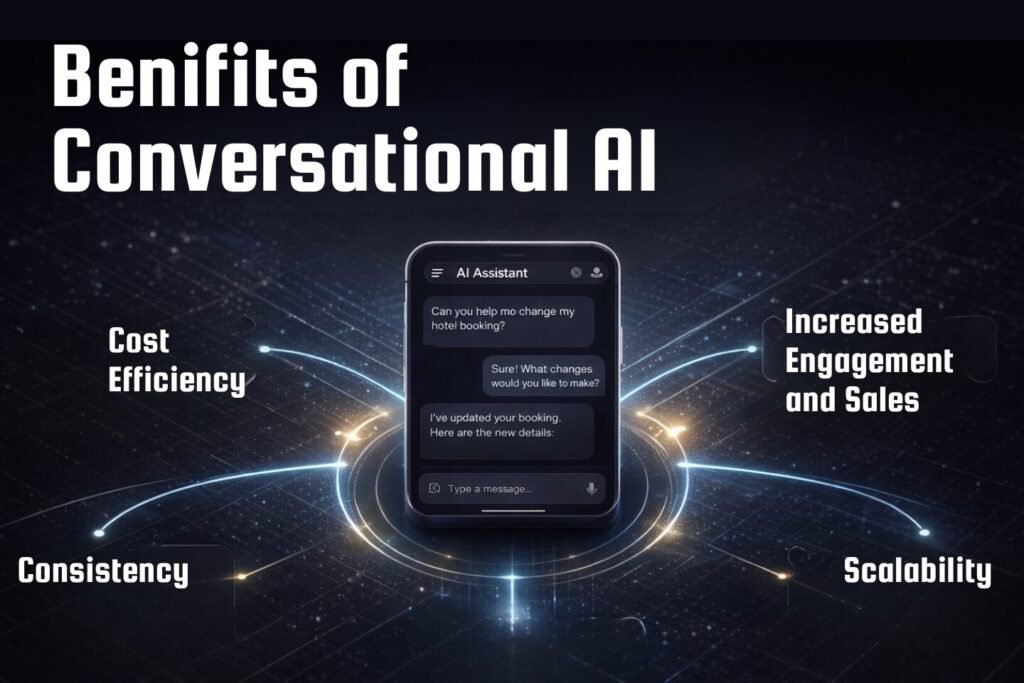
Conversational AI delivers clear business value:
Cost Efficiency
Automates repetitive interactions to reduce staffing and operational costs.
Increased Engagement and Sales
Instant responses boost customer satisfaction, loyalty, and conversion rates.
Scalability
Handles large volumes of conversations without the addition of human resources.
Consistency
Delivers consistent and accurate responses across channels and time zones.
Challenges of Conversational AI
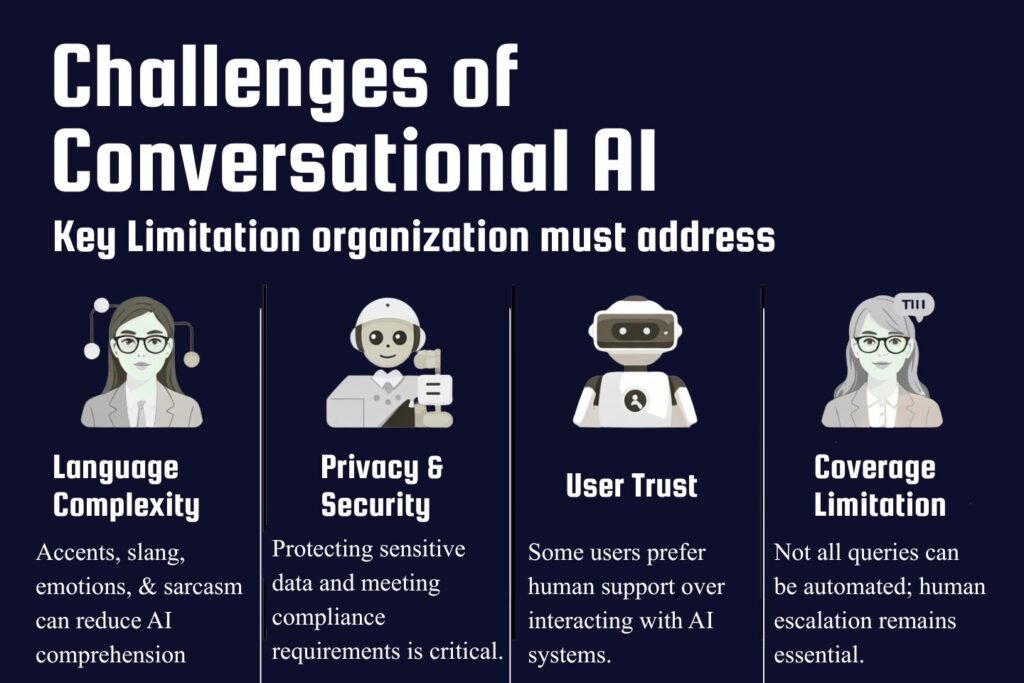
Despite its value, Conversational AI faces challenges:
Language Complexity
Accents, slang, emotions, and sarcasm all impact comprehension.
PRIVACY AND SECURITY
Data protection and compliance are key aspects of handling sensitive information.
User Trust
Because many users may be uneasy with interacting with AI systems, some would instead prefer to get human support.
Coverage Limitations
Not all queries can be automated; therefore, human escalation is always essential.
The Future of Conversational AI
Conversational AI is progressing quickly. Future systems will be more proactive and emotionally intelligent, as well as being able to use more languages via multiple platforms. Voice, multi-modal interfaces, and much deeper levels of personalization are expected to become commonplace.
For businesses, conversational AI is quickly becoming a required component of customer experience and digital operations.
Final Takeaway
Conversational AI technology is changing the way many organizations communicate. Conversational AI decreases operational costs, increases customer engagement levels, and provides superior overall user experiences. With continued advances in technology, Conversational AI will define how humans will interact with an increasingly digital world.
Want to explore how conversational AI is shaping real-world customer experiences?
Discover insights from industry leaders at the Conversational AI & Customer Experience Summit.
FAQ’s
Conversational AI is a type of AI that allows machines to communicate with people in natural language. This technology powers chatbots, virtual assistants, voice systems, and any interaction between a machine and a human where the machine is able to understand what the human wants through intent recognition and provide smart responses back.
In traditional chatbots, there is a precalculated sequence of interactions that must be followed by both the user and the chatbot; Conversational AI allows users to create new sequences of interaction through the use of machine learning and natural language processing and allows the system to develop a better understanding of the user's intent, so it can improve over time and provide better responses.
Conversational AI uses a combination of Natural Language Processing and Machine Learning coupled with Natural Language Generation and Speech Recognition to derive meaning from user interaction and form appropriate responses to the User.
In addition to Customer Service, Sales, Marketing, Banking, Health, HR, IT Support, etc., Conversational AI can be used for Voice-Enabled Internet of Things (IoT) devices such as Smart Assistants.
Conversational AI is able to improve the Customer Experience through the ability of providing instant responsiveness, 24/7 availability, personalization, and consistency in experience across all Digital Channels.
Operational Expenses are cut with Conversational AI. Also, they will Boost Agent Productivity, Scale Interaction between a Business and Customers, Increase Customer Interactivity, and Allow for Agents to Focus on Higher Commerce Issue
Conversational AI Today supports multiple languages and provides Training Focused on Region, therefore, they are a Perfect Match for Global Companies.
Conversational AI can be Extremely Safe. They Are Designed, Trained, and Governed With Strong Data Security, Encryption Methods, and Compliance. Therefore, Security Depends On How the Technology Is Designed, Trained, and Governed.
Examples of Common Challenges Are: Understanding Complex Language; Dealing With Emotion, Sarcasm; Ensuring Data Privacy; Building User Trust; and Managing a Seamless Transfer to A Human Agent.
The Future for Conversational AI. will include More Proactive Engagement, More Personalized Experiences, Voice and Multi-modal Use of Technology, and Fully Integrated into Enterprise Systems making Conversations the Pillar of Digital Experience.