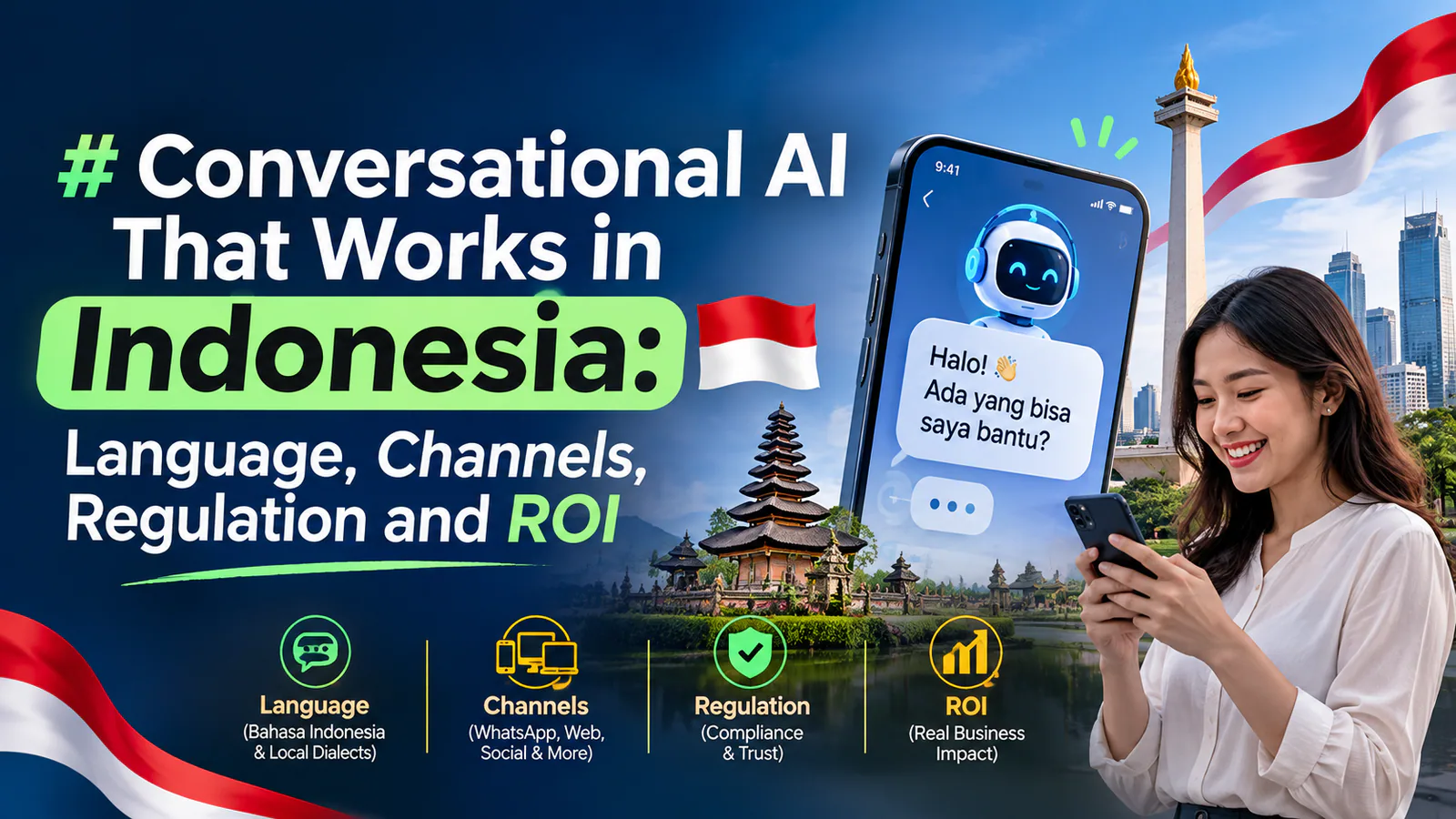

Conversational AI is one of the forces changing most how companies talk to their customers, employees and users. Through chatbots, virtual assistants and voice systems, it lets machines understand people and answer them in a natural way, at scale.
This guide covers what conversational AI is, how it works, the technology behind it, where businesses use it, and why it has become the digital foundation of modern customer interaction.
What is conversational AI?
Conversational AI is any technology that lets people talk to computer systems the way they talk to each other, by text or by voice. Its job is to understand what someone says, work out what they mean, and reply with something relevant, quickly.
Traditional chatbots follow pre-written scripts. Conversational AI uses machine learning to learn from earlier conversations and improve as it's used, so it adapts to how people really speak across channels and contexts.
It powers chatbots, automated virtual agents, voice assistants, and messaging systems used in customer support, sales, healthcare, banking and enterprise automation.
How it works
Three technologies work together in a cycle of continuous learning.
- Natural language processing (NLP) lets the system understand how people communicate: sentence structure, meaning and context.
- Machine learning (ML) improves accuracy over time. The more conversations the system sees, the better it recognises patterns and intent.
- Natural language generation (NLG) writes replies that read naturally and make sense.
How to build conversational AI
Building conversational AI starts with what users need, not with the technology.
- Find the frequently asked questions. They show what users care about most and set the first scope of automation.
- Turn questions into intents. Each question becomes an intent the system learns to recognise, including the many ways people phrase it.
- Define entities. These are the details attached to an intent, such as account numbers, dates, places or product names.
- Design the conversation. Intents and entities combine into dialogue flows that guide people to an answer.
The parts of a conversational AI system
- Input: voice or text, from a website, an app or a messaging platform.
- Recognition: text is analysed by natural language understanding (NLU); voice goes through automatic speech recognition (ASR) first.
- Dialogue management: decides how to respond, keeps the conversation flowing and remembers context.
- Learning: successful and unsuccessful conversations both feed back into the model.
Where businesses use it
- Customer support: answering common questions, tracking orders, troubleshooting and escalating to people.
- Sales and marketing: qualifying leads, recommending products and guiding purchases.
- Banking and finance: account questions, transactions and fraud alerts.
- Healthcare: appointment booking, symptom checks and patient engagement.
- HR and IT: onboarding, training and internal help desks.
- Voice and devices: smart assistants and voice-controlled systems.
Why it matters in Asia
Service around the clock, across time zones. Businesses in Southeast Asia often serve customers in several countries and languages from one platform. Conversational AI keeps service running at night without a 24-hour contact centre.
Many languages, many channels. A well-trained system can handle Bahasa Indonesia, Bahasa Malaysia, Mandarin, Thai, Tagalog and English from one deployment, on the web, WhatsApp, in apps and by voice.
Lower cost at scale. Automating even 30–40% of first-line contact-centre conversations lowers the cost per contact and frees people for the conversations that need human judgement.
Consistent, measurable service. Every answer follows the same standard and every conversation is logged, which makes performance easy to measure and improve.
A way to stand out. Where products look alike, customer experience is where companies compete. Brands such as DBS, OCBC, AirAsia and Lazada invest in conversational AI for speed, personalisation and context, not only to cut costs.
The challenges
- Language is hard: accents, slang, emotion and sarcasm all affect understanding.
- Privacy and security: sensitive data has to be protected and handled in line with the law.
- Trust: some customers would rather speak to a person.
- Coverage: not everything can be automated, so a clean hand-over to people is essential.
What comes next, 2026 to 2028
Agentic AI. Systems that don't just answer but act: booking a flight, processing a refund, updating an address or filing a claim from start to finish. Service moves from chat support to AI-driven process automation.
Multimodal conversations. Customers will combine text, voice, images and video. A customer photographs a damaged product, describes it in a voice note, and the AI starts the return.
Personalisation at scale. Systems will adapt tone, pace, language and recommendations to each customer's history, preferences and mood.
Emotionally aware AI. Sentiment analysis lets systems notice frustration or urgency and change course, or bring in a person, before a customer gives up.
Regulation. Singapore's Model AI Governance Framework already shapes how organisations deploy conversational AI, and Indonesia, Malaysia and Thailand are developing their own approaches. Companies that build governance in now will be ready as the rules evolve.
The takeaway
Conversational AI lowers operating costs, raises engagement and gives customers a better experience. As the technology advances, it will define how people interact with an increasingly digital world.
To see how leading companies are using it, join the operators who present their work at the Conversational AI & Customer Experience Summit.